
A food vending machine sells something perishable, fragile or both, without a counter, and does it safely. That is a harder job than selling cans. Food safety rules apply as soon as one item needs temperature control. Cream cakes crush, pizza needs heat, and bread stales. The machine has to suit the food rather than the other way round. KioskForce builds food vending machines to order. We specify the cabinet, temperature control, delivery mechanism, payment and software from your menu and your site, then quote them.
Quick answer
- The product decides the cabinet. Ambient for cookies, bread and packaged snacks; chilled for cream cakes, sandwiches, dairy and meals; frozen for ice cream; heated for hot food.
- Chilled food has hard rules. In the US model code, food that needs temperature control is held at 5 °C (41 °F) or below, and the machine must stop selling automatically if it cannot hold that temperature.
- Fragile food should not drop. Use a lift (elevator) or a locker door for cakes, glass jars and boxed items. Firm packs can go on spiral coils.
- We build the cabinets, not the kitchens. Ambient and refrigerated touchscreen machines, lift and locker delivery, chilled locker cells to order, and an optional per-cell heating pad. Bake-from-scratch pizza ovens and robotic noodle cookers are specialist machines we do not make.
- Published starting prices: BG10X10 from USD 1,200 and KF10X22 from USD 2,100, ambient or refrigerated. Custom food builds are quoted. See vending machine cost.
What counts as a food vending machine
The FDA Food Code defines a vending machine as “a self-service device that, upon insertion of a coin, paper currency, token, card, or key, or by electronic transaction or optional manual operation, dispenses unit servings of food in bulk or in packages”. That covers a wide range of hardware. The useful split is by what the food needs:
| Type | Holds food at | Typical products | What makes it work |
|---|---|---|---|
| Ambient food vending machine | Room temperature | Cookies, bread, packaged snacks, cup noodles | Packaging that survives the machine; date control |
| Refrigerated (fresh) food vending machine | 5 °C (41 °F) or below in the US model | Cream cakes, sandwiches, salads, dairy, chilled meals | Automatic shutoff, temperature in the warmest spot, date marking |
| Frozen vending machine | Freezer temperature | Ice cream, frozen desserts and meals | A freezer-grade refrigeration design, not a chilled setting |
| Hot food vending machine | Chilled, then heated on demand; or held hot | Ready meals, pizza, soups | A heating stage or a hot-holding cabinet, plus cycle control |
| Locker or bread wall | Ambient, chilled or heated per cell | Bread, cakes, meal boxes, pre-orders | One door per item; refill from the back |
| Hot-water and noodle machine | Ambient stock, hot water at the point of sale | Cup noodles, instant soups | A hot-water supply beside or in the cabinet |
Most food projects mix two of these, for example a chilled cabinet with lift delivery for cake slices, beside an ambient coil section for cookies.
Food safety: the rules that shape the machine
This is a summary for planning, not legal advice. Rules change; confirm with the regulator where the machine will stand. Facts are as of October 2026.
In the US, food rules come from the FDA Food Code, a model that state and local health departments adopt in some edition. The FDA released the 2026 edition in September 2026, and your county may still enforce an older one. Four of its sections shape a food vending machine:
- Hot and cold holding (§3-501.16). Time/temperature control for safety (TCS) food is held at 57 °C (135 °F) or above, or 5 °C (41 °F) or less.
- Automatic shutoff (§4-204.111). A machine vending TCS food must stop vending after a power failure, a mechanical failure or any other condition that means it cannot hold safe temperatures. It stays locked until it is serviced and restocked with food kept at safe temperatures. After restocking, a refrigerated machine may not run above 5 °C for more than 30 minutes, and a hot-holding machine may not run below 57 °C for more than 120 minutes.
- Where the temperature is measured (§4-204.112). The sensor reads the warmest part of a refrigerated unit and the coolest part of a hot unit.
- Date marking (§3-501.17). Refrigerated, ready-to-eat TCS food prepared on site and held more than 24 hours is marked for sale or discard within seven days at 5 °C or below, counting the day of preparation as day 1.
Whether a food is TCS depends on its water activity and pH, set out in tables in the Food Code definition. Many baked goods are dry enough not to need it. Cream, custard and dairy-based fillings usually do. The same idea appears elsewhere:
| United States (FDA Food Code model) | England | Australia | |
|---|---|---|---|
| Cold holding | 5 °C (41 °F) or less | 8 °C legal maximum for food likely to support pathogen growth | 5 °C or colder |
| Hot holding | 57 °C (135 °F) or above | 63 °C or above | 60 °C or hotter |
| Food that may stay ambient | Non-TCS food, decided by water activity and pH | Food that can be kept at ambient for its shelf life with no risk to health is outside the rules | Food that is not potentially hazardous |
| Examples named by the regulator | Cut fruit, heat-treated plant food, raw or cooked animal food | — | Cream, fresh custard, cooked rice, pasta, sandwiches, pizzas |
| Source | Food Code 2026 §3-501.16, §4-204.111 | Food Safety and Hygiene (England) Regulations 2013, Schedule 4 | FSANZ, “Keeping food at the right temperature” |
KioskForce refrigerated machines have a health-control block that stops sales when the cabinet goes out of temperature range. We set the threshold, the time allowed above it and how the block is cleared to your food-safety rules; we do not publish a default. Temperature is reported to the cloud dashboard with alerts. We build to the requirement you state. We do not certify that a machine or a menu complies with your food law; your regulator does that.
Two more US rules apply to many food machines. The Food Code (§4-204.14) wants a self-closing door on the dispensing compartment of any vending machine, snack machines included, that stands outdoors or runs without full-time supervision. US calorie labelling for vending (21 CFR 101.8) applies to operators with 20 or more machines and to operators who register voluntarily. On a machine with a digital display, the calories must show before the customer buys.
What KioskForce builds, and what it does not
Here is what we build, with each item backed by a published page on this site:
- Touchscreen platforms, ambient or refrigerated. The BG10X10 (10-inch sidecar screen, from USD 1,200), the narrow KF6X10 (616 mm wide, quoted on request) and the full-size KF10X22 (22-inch screen, from USD 2,100). Refrigerant is R290 or R134a, chosen for the destination market. The refrigerated vending machines guide covers the choice.
- Delivery mechanisms chosen per product. Spiral coils, a lift (elevator) with drop sensor, or locker cells, or a mix of them in one cabinet.
- Locker cabinets and bread walls. The K180-6C locker kiosk (from USD 1,800) and L180-10C locker cabinets. Cells can be sized to order, and the locker configurator gives an instant estimate for a custom cabinet.
- Chilled locker cells, supplied to order as a custom build and quoted per project. See refrigerated lockers.
- An optional per-cell heating pad on locker cells, with active ventilation as standard. We do not publish a guaranteed holding temperature for it. See heated and chilled food pickup lockers.
- Software: per-item stock, temperature and door events on the cloud dashboard, remote pricing and promotions through VoTi remote configuration, and a nutrition and allergen panel on the product screen.
What we do not build: bake-from-scratch or robotic pizza ovens, robotic noodle-cooking machines, or soft-serve machines. Those are specialist products, and their makers are the right people to ask. Where a project needs one, we can tell you which parts of it (a chilled pickup locker, a payment kiosk, a bakery wall) are ours to supply.
Food by food
Cakes and cupcakes
Cake is the clearest case for a lift or a locker. A frosted cupcake or a cake slice does not survive a drop. Cream, custard and cream-cheese finishes usually push the product into chilled holding. The best-known example, Sprinkles’ “cupcake ATMs”, closed with the rest of the chain on 31 December 2025, but independent bakeries keep opening refrigerated cake machines. See cupcake and cake vending machines.
Cookies
Most plain cookies are shelf-stable, so a cookie machine is mostly a packaging and freshness problem, and an ambient cabinet often does the job. The hard part is “warm”, which is a heating question. See cookie vending machines.
Bread and bakery
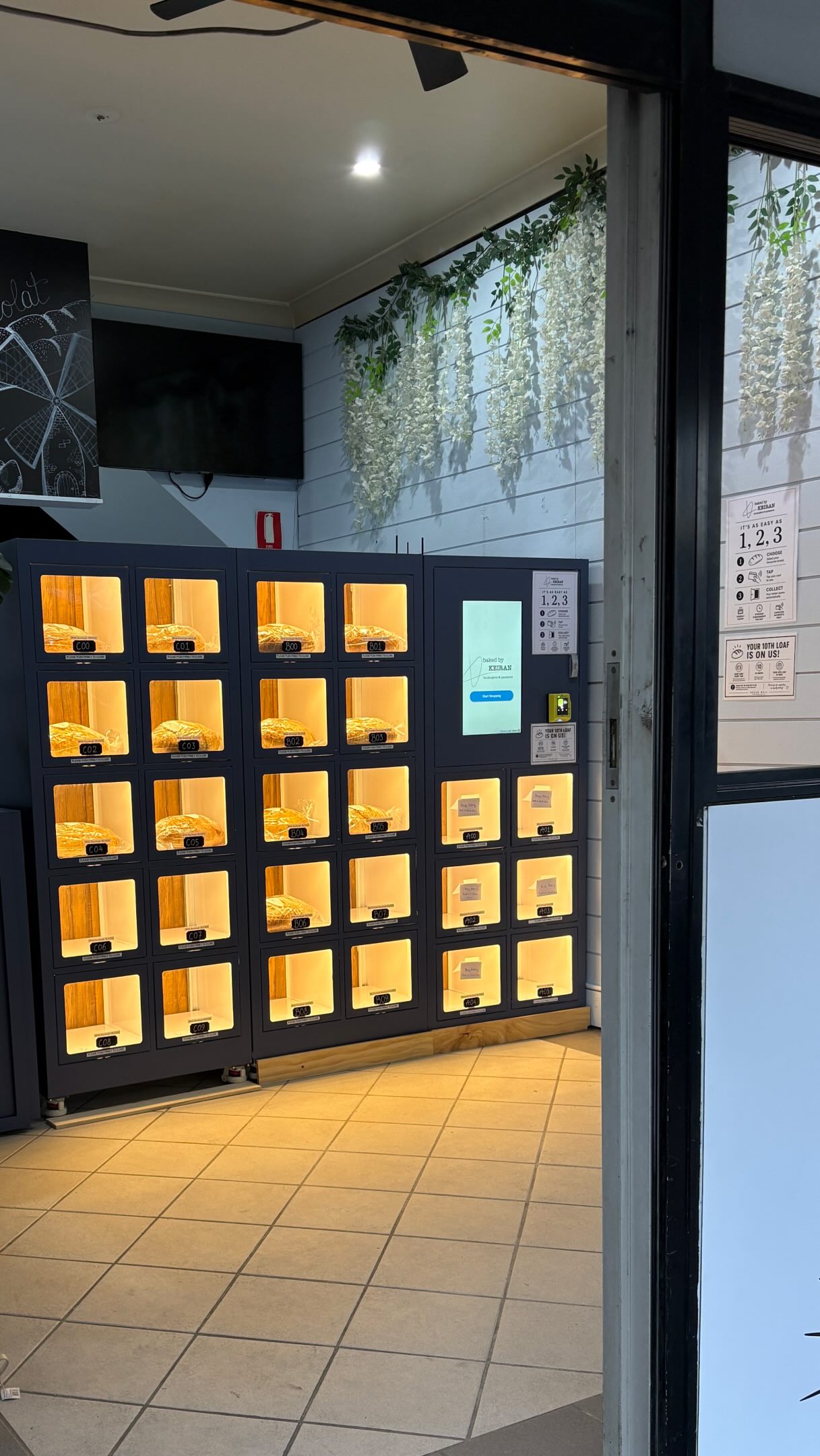
The bread-wall model sells from illuminated locker doors at the front and refills from the bakery at the back. A Sydney bakery’s bread wall uses one K180-6C kiosk and two L180-10C locker cabinets, 26 compartments in total, supplied through our authorised Sydney distributor. See bread and bakery vending machines.
Pizza
Pizza machines come in three kinds: bake-to-order machines that cook from stored ingredients, reheat machines that heat a pre-made pizza, and pickup lockers that hold a pizza the kitchen has just made. As an example of the first kind, a SpeedyPie machine that opened in Bettendorf, Iowa, in August 2026 holds up to 70 pizzas, priced from US$12.99 to US$14.99 (KWQC). We supply the locker route, not the oven. See pizza vending machines.
Ramen and noodles
A ramen vending machine is either a cup-noodle machine with hot water, or a specialist machine that cooks a bowl. The first is a coil or lift cabinet plus a hot-water supply. Our instant noodle dispensing guide covers coil sizing. See ramen vending machines.
Hot meals
Most hot food vending machines refrigerate meals and heat each one after payment. We explain how the heating works in how hot food vending machines work. The commercial and specification side is on hot food vending machines.
Desserts and ice cream
Chilled desserts are a refrigerated cabinet with lift delivery. Ice cream needs a freezer, which is a different refrigeration design and has to be raised at the start of a project. See dessert vending machines.
Korean-style unmanned stores
Unmanned food stores combine vending machines, smart fridges and self-checkout. See Korean vending machines, and smart fridge vs refrigerated vending machine for the open-door alternative.
Delivery: coil, lift or locker
| Mechanism | How the food reaches the customer | Good for | Watch for |
|---|---|---|---|
| Spiral coil | The coil turns and the pack drops to a bin | Flow-wrapped cookies, bars, bottles, firm packs, cup noodles | Drop damage to anything soft, frosted or lidded |
| Lift (elevator) with drop sensor | A lift carries the item down to the delivery port, and a sensor confirms it arrived | Cake slices, cupcakes in clamshells, dessert pots, glass jars | One selection per purchase, so the sensor can confirm each item |
| Locker cells | A door opens on the compartment holding the item | Whole cakes, bread, meal boxes, pizza boxes, pre-orders | One item or order per cell; chilled and heated cells are build-time choices |
On our machines the lift switches the purchase flow to one selection at a time so the drop sensor can confirm each item (dispense reliability). Capacity per selection is the tray depth divided by the pack depth. Send packaging dimensions before anything else, and use the planogram configurator to lay out selections.
Labelling, allergens and the screen
- Allergens. US packaged food must identify the nine major allergens: milk, eggs, fish, crustacean shellfish, tree nuts, peanuts, wheat, soybeans and sesame (sesame since 1 January 2023). Bakery food often contains several of them.
- UK food packed where it is sold. Food “packaged at the same place it is offered or sold to consumers” before it is ordered (prepacked for direct sale, or PPDS) needs the name of the food and a full ingredients list with the 14 allergens emphasised. This has applied since 1 October 2021. A bakery that packs its own cakes and sells them from a machine at the shop should read the Food Standards Agency guidance.
- Calories. 21 CFR 101.8 in the US, as above.
- The screen helps. A touchscreen shows a nutrition and allergen panel per product, updated centrally. It does not replace the label on the pack.
Payment
Food buyers expect to tap. The options on our payments matrix all apply to food: MDB cashless terminals (Vending on Track VendCoin, Nayax, Cantaloupe and others) for cards and phone wallets, on-screen QR wallets, RFID badge or PIN accounts for staff meal allowances, and coins and notes where cash is still needed. The machine writes its own order record, so the dashboard shows which item sold on a card payment, not only the amount.
Price and lead time
| Platform or option | Published starting price (USD) |
|---|---|
| Compact wall-mount vending machine (ambient; packaged snacks) | 800–1,500 |
| BG10X10 touchscreen, ambient or refrigerated | from 1,200 |
| K180-6C locker kiosk, six cells | from 1,800 |
| KF10X22 full-size touchscreen, ambient or refrigerated | from 2,100 |
| KF6X10 narrow touchscreen, ambient or refrigerated | on request |
| Chilled locker cells, lift builds, heated cells, custom cabinets | quoted per project |
Refrigeration costs more than ambient. A lift, locker cells, a heated or chilled cell, a larger screen, payment hardware, branding and quantity all move the price. Freight, duty, installation and processing fees sit on top. See vending machine cost and shipping and landed cost. Lead times are 4–6 weeks for a modified standard model and 8–12 weeks for a custom build. A 4G data plan typically costs USD 5–10 per machine per month.
Where a food vending machine is the wrong answer
- Low traffic. Food expires. With too few buyers, a fresh-food machine becomes a waste bin. Start with shelf-stable stock and test demand.
- Nobody owns restocking and dates. A chilled machine without a named person for date control is a food-safety risk, whatever its shutoff does.
- Shoppers want to browse and pick up several items. An open-door smart fridge or a staffed counter suits that better.
- You want food cooked from raw in the machine. That is a specialist cooking appliance. Buy it from its maker.
- The food cannot be packed to survive the machine. Fix the pack first. No mechanism rescues a product that collapses in its box.
What to send with an enquiry
- The menu, with each item’s packaging dimensions as loaded, its weight, and whether it needs chilling, freezing or heat.
- Your food-safety requirement: the holding temperature, the shutoff threshold and time, and who clears a lockout.
- Daily volume and how often you can restock.
- The site: indoor or outdoor, floor or wall, power and network, and whether the machine is supervised.
- Payment, and any card terminal you already use.
- Labelling: the nutrition and allergen data you will show on screen.
- Number of machines, destination country and timeline.
Questions to ask any food vending supplier
- Which holding temperature does this configuration hold, measured where, at what room temperature?
- Does it stop selling automatically on a temperature or power fault, and how is the lockout cleared?
- Which mechanism delivers each of my products without damage?
- What does the dashboard show: stock, temperature history, door events, item-level card sales?
- Can I change prices and run an end-of-day markdown remotely?
- Who handles warranty and spare parts in my country?
How KioskForce answers
| Point | Our answer |
|---|---|
| Design | Built to order around your menu; not a catalogue machine |
| Temperature | Ambient or refrigerated platforms; chilled locker cells to order; frozen raised as a separate specification |
| Fault behaviour | Health-control block stops sales out of range; threshold and clearing set to your rules |
| Delivery | Coils, lift with drop sensor, locker cells, or a mix, per product |
| Heat | Optional per-cell heating pad on lockers; no published hot-holding temperature; no ovens |
| Data | Item-level sales, stock, temperature and door events; remote pricing and promotions |
| Price | Published platform bands above; custom food builds quoted |
| Installation and support | Installation optional, in some regions through a local distributor; support by email; where a distributor supplied the machine, it handles warranty and service |
| Manufacturing | Hardware and software designed in-house in Nanjing; built in partner factories in China |
Every page in this cluster
- Bread Vending Machine: The Bread-Wall Model for Bakeries — A bread vending machine sells finished loaves from locker cells or bakes par-baked bread on demand. How the bread-wall model works, sizing, labels and costs.
- Cookie Vending Machines for Bakeries and Cookie Brands — Cookie vending machines for bakeries and cookie brands: packaging that keeps vending machine cookies fresh, coil vs lift, warm-cookie options and costs.
- Cupcake Vending Machines: Cake Slices, Whole Cakes and Chilling — Cupcake and cake vending machines: when cake must be chilled, lift vs locker delivery, box sizing, shelf life, labelling and what a machine costs to buy.
- Dessert Vending Machine Guide: Chilled Cakes to Ice Cream — A dessert vending machine is chilled (cake, mousse, tiramisu) or frozen (ice cream), never both by default. Temperature rules, packaging and what to specify.
- Food Vending Machine Regulations: Permits, Temperature and Labels — Food vending machine regulations in the US, UK and Australia: the permit or registration you need, cold and hot holding limits, calorie labels and outdoor rules.
- Hot Food Vending Machines: Types, Costs and What to Specify — Buying a hot food vending machine: the five types, the rules that shape the build, throughput arithmetic, what drives cost, and what to put in the spec.
- How Much Does a Food Vending Machine Cost? Prices by Type — Food vending machine cost by type: published prices from USD 800 to 2,100, what chilled, heated and locker builds add, and the running costs of selling food.
- Korean Vending Machines and Unmanned Stores: What to Copy — Korean vending machines grew into unmanned stores selling ice cream, ramen and coffee. What they sell, the rules and problems, and what operators can copy.
- Pizza Vending Machines: Bake-to-Order, Reheat or Pickup Locker? — Pizza vending machines come in three types: bake from scratch, bake a chilled pre-made pizza, or a pickup locker for your own pizzas. How each works and costs.
- Ramen Vending Machines: Cup Noodles, Hot Water or Cooked Bowls — A ramen vending machine either sells cup noodles with hot water or cooks a bowl to order. How each type works, Japan's examples, the rules, and what to specify.
Frequently asked questions
What is a food vending machine?
A food vending machine is a self-service cabinet that sells food without staff once the customer has paid. The FDA Food Code defines a vending machine as a self-service device that dispenses unit servings of food after a coin, card, key or electronic transaction. In practice the term covers ambient snack machines, refrigerated machines for fresh food, freezer machines for ice cream, machines that heat a chilled meal on demand, and locker walls that sell bakery items from individual doors. The product decides which one you need.
Does a food vending machine need to be refrigerated?
Only if it sells food that needs temperature control. Under the FDA Food Code model, time/temperature control for safety food such as sandwiches, cut fruit, dairy, cream and custard fillings and cooked meals must be held at 5 degrees C (41 degrees F) or below, and a machine vending it must stop selling automatically if it cannot hold that temperature. Plain cookies, bread and most packaged snacks can be sold from an ambient cabinet. England sets a legal maximum of 8 degrees C for chilled food that supports pathogen growth, and Australia uses 5 degrees C.
Can KioskForce build a food vending machine?
Yes. KioskForce builds food vending machines to order: the BG10X10, KF6X10 and KF10X22 touchscreen platforms in ambient or refrigerated versions, lift (elevator) delivery for fragile items, locker cabinets for bakery and pickup, chilled locker cells as a custom build quoted per project, and an optional per-cell heating pad on locker cells. Refrigerated machines have a health-control block that stops sales when the cabinet leaves its temperature range. We do not build bake-from-scratch pizza ovens or robotic noodle-cooking machines.
How much does a food vending machine cost?
KioskForce publishes indicative starting prices for its platforms: the BG10X10 touchscreen machine from USD 1,200 and the KF10X22 from USD 2,100, each in ambient or refrigerated versions, with refrigeration adding to the price. The K180-6C locker kiosk starts from USD 1,800. Chilled locker cells, lift delivery, heated cells and custom cabinets are quoted per project. Freight, import duty, installation and payment processing fees sit on top of the machine price.
What food sells best from a vending machine?
Food that a location already wants when no counter is open, packed so it survives the machine. A bakery’s own products sell after hours outside the shop; cookies and cake slices sell in airports and campuses; chilled meals and sandwiches sell to night-shift workers and hospital staff; cup noodles sell where there is hot water. The machine multiplies existing demand at a site. It does not create it, so start from the location and the buyers before choosing the menu.
Do food vending machines have to show calories and allergens?
In the US, operators with 20 or more vending machines, and operators who register voluntarily, must disclose calories under 21 CFR 101.8 unless the Nutrition Facts are visible through the glass; on an electronic display machine the calories must show before purchase. Packaged food must also declare the nine major allergens under US labelling law. In the UK, food packed on the same premises where it is sold needs a full ingredients list with allergens emphasised. A touchscreen can show nutrition and allergen panels per product.
Can a vending machine sell hot food?
Yes, in two ways. Most hot food vending machines store meals chilled and heat each one after payment, which is a specialist machine combining refrigeration and an oven. The other approach holds food hot, and the FDA Food Code model then requires the cabinet air to stay at 57 degrees C (135 degrees F) or above, with an automatic shutoff. KioskForce offers an optional heating pad on locker cells for pickup orders and does not publish a hot-holding temperature for it, so a hot-holding requirement must be stated at enquiry.
Who installs and services a food vending machine from KioskForce?
On-site installation is optional. It is done by your own contractor from our drawings and guidance or, in some regions, provided through a local distributor. KioskForce supports machines by email and ships spare parts. Where a local distributor supplied the machine, that distributor handles warranty and service. We sell direct and, in some regions, through local distributors, and every machine carries a 12-month warranty on manufacturing defects.
Can a food vending machine go outdoors?
It can be specified for an outdoor or semi-outdoor position, but the build changes and food makes it harder. Sun and heat load the refrigeration, condensation forms on chilled glass, and the FDA Food Code model asks for a self-closing door on the dispensing compartment of a machine that stands outdoors or runs unsupervised. An unattended outdoor cabinet is also a security risk. State the position at enquiry, because it changes the cabinet, the refrigeration and the security specification.
References
- US Food and Drug Administration — “Food Code 2026”, definitions and §§3-501.16, 3-501.17, 4-204.14, 4-204.111, 4-204.112 (released September 2026; accessed 3 October 2026). https://www.fda.gov/food/fda-food-code/food-code-2026
- legislation.gov.uk — “The Food Safety and Hygiene (England) Regulations 2013, Schedule 4: Temperature control requirements” (accessed 3 October 2026). https://www.legislation.gov.uk/uksi/2013/2996/schedule/4
- Food Standards Australia New Zealand — “Keeping food at the right temperature” (updated 30 September 2025; accessed 3 October 2026). https://www.foodstandards.gov.au/business/food-safety/keeping-food-at-the-right-temperature
- eCFR via Cornell LII — 21 CFR 101.8, “Vending machines” (calorie labelling; accessed 3 October 2026). https://www.law.cornell.edu/cfr/text/21/101.8
- US Food and Drug Administration — “Food Allergies” (content current as of 11 March 2026; accessed 3 October 2026). https://www.fda.gov/food/nutrition-food-labeling-and-critical-foods/food-allergies
- Food Standards Agency (GOV.UK) — “Introduction to allergen labelling for PPDS food” (updated 17 July 2026; accessed 3 October 2026). https://www.gov.uk/government/publications/introduction-to-allergen-labelling-for-ppds-food/introduction-to-allergen-labelling-for-ppds-food
- CBS News Los Angeles — “Sprinkles cupcake chain closing” (31 December 2025). https://www.cbsnews.com/losangeles/news/sprinkles-cupcake-chain-closing/
- KWQC — “You can now get pizza from a vending machine in the QCA” (24 August 2026). https://www.kwqc.com/2026/08/24/you-can-now-get-pizza-vending-machine-qca/
Related
- Refrigerated vending machines for fresh and healthy food: cold holding, shutoff, refrigerants and prices.
- Smart fridge vs refrigerated vending machine: open-door grab-and-go against one-item-at-a-time vending.
- Sydney bakery bread wall: the bakery locker wall case study.
- How hot food vending machines work: heating methods and cycle logging.
- Heated and chilled food pickup lockers: holding rules for pre-ordered food.
- Instant noodle dispensing: coil sizing for cups and bowls.
- Vending machine cost: published price bands across machine types.
Talk to us about a food vending machine
Send the menu with packaging dimensions, the temperature each item needs, your daily volume, the site and how people will pay. We will propose a cabinet, delivery mechanism and temperature setup, and quote it.
Project brief · 60 seconds
What are we building together?
Three quick steps. Your brief goes straight to the engineers who design, build and support KioskForce systems.

