
The short answer
A harm reduction vending machine is a locked cabinet that hands out naloxone, sterile injecting equipment, sharps containers, test strips and other health supplies one unit at a time, usually free, at hours and in places where a staffed service is closed or not used. Programs run them; the machine enforces the program’s rules. Those rules are what this page is about: what gets dispensed, how release is controlled, what the machine may ask, and what the law and funders allow as of October 2026.
Two capabilities set a good machine apart. Controlled dispensing: stock is locked away, each vend releases one counted unit, and per-vend and per-period limits apply. Form inputs: a few short, anonymous questions on the machine’s optional touchscreen or the user’s phone, answered before release, so the funder gets evaluation data without anyone being identified or turned away.
We build to the requirement your program states, and we do not certify that a machine or its contents comply with any drug, medicines or paraphernalia law. We have not yet supplied a syringe, naloxone or test-strip machine. What we have delivered, and what carries over, is set out below.
What harm reduction vending machines dispense
| Product | Why programs stock it | Typical control | Notes |
|---|---|---|---|
| Naloxone (nasal spray, carton of two) | Reverses opioid overdose; given to people who may witness one | Open push button with a per-vend cap of one or two | Storage 2–25 °C, never frozen (US Narcan label); see naloxone vending machines |
| Syringes / fitpacks | Prevent HIV and hepatitis C transmission | Push button, code, token or program card; often a per-period quota in US programs | Usually 1 ml needle-syringes, swabs and water inside a small sharps container |
| Sharps containers | Safe disposal at home | Open, per-vend cap | Pair with a collection bin beside the machine |
| Fentanyl and xylazine test strips | Check a sample before use | Open or code; per-vend cap | Paraphernalia rules vary by US state |
| Safer-sex supplies (condoms, lubricant) | Sexual health | Open | Often in the same cabinet |
| Wound-care and hygiene kits | Skin and soft-tissue infections | Open or code | Bulky; size coils to the kit |
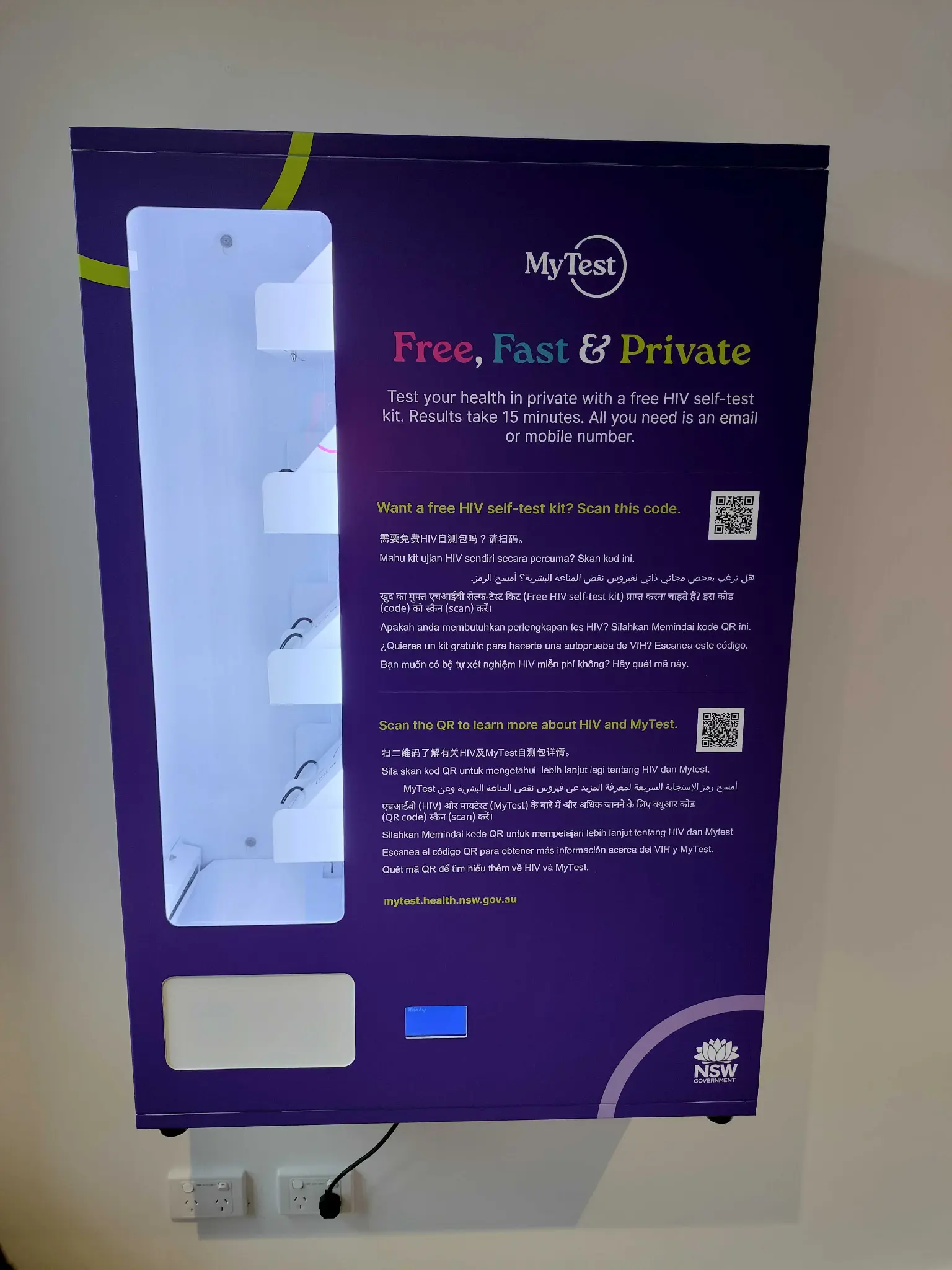
| HIV and hepatitis C self-tests | Testing outside clinic hours | Code or QR after registration, per-person quota | The model we have delivered for HIV self-tests |
What a program may stock, and who may pay for it, is a legal and funding question covered below. The coil setups for each product size are on public health vending.
Controlled dispensing
The user never touches the stock. A coil pushes one item into a secure delivery bin, and the machine decides whether to release at all. On top of that mechanism, programs choose an access method and a limit:
- Access: anonymous push button, token, postcode or ZIP entry, a code issued by staff or by phone, a QR scan, or a program card and PIN.
- Limits: a per-vend cap needs no identity. A per-week or per-month quota needs a code or card to count against, and on our platform it is enforced in the cloud across every machine in the program.
- Mixed machines: many programs keep naloxone open and put syringes or other items behind a code.
Published programs show the range. New York City’s machines ask for a NYC ZIP code before release. Caracole in Cincinnati issues a personal code after a brief sign-up survey, good for one visit a week for 90 days. In Las Vegas, clients enrol online, collect a vending card with ID, and use their own card or PIN. The full comparison, including what happens when a limit is hit and how machines behave offline, is in controlled dispensing on harm reduction vending machines.
Form inputs: questions before release
Funders need evidence; people who use drugs often avoid anything that identifies them. A short, optional set of questions answered before release serves both. The questions can run on the machine’s optional touchscreen (7 to 32 inches on our wall-mount units) or on the user’s phone after scanning a QR code, which keeps a screen-free cabinet possible. Typical questions:
- First supply or refill?
- Was the last kit used, for example to reverse an overdose?
- Age band, recorded but never used to refuse.
- Postcode or ZIP.
The rules that keep this from becoming a barrier: ask but never block, keep it to a few taps, make every question skippable, and store nothing personal on the machine. NSW’s needle and syringe program guideline says surveys must be voluntary and based on informed consent, and warns against “unwanted educational or referral interventions which may discourage future access”. What to ask, what not to ask and how answers reach the funder’s report are in on-screen questions and forms on harm reduction vending machines.
Naloxone vending machines
Naloxone is the product most new programs start with, and it has its own guide: naloxone (Narcan) vending machines covers the legal position in the US and Australia, access models, the storage label and what it means for the cabinet, and the evidence. It lives in our medicine cluster because naloxone is a medicine.
Two points matter at hub level. First, temperature: compact wall-mount units are ambient, so a naloxone machine belongs in a conditioned indoor position or needs a cabinet and monitoring chosen for the site. Refrigerated cabinets are available on the floor-standing KF10X22, BG10X10 and KF6X10. Second, procurement: if you are writing a tender, the naloxone dispensing machine specification lists the requirements to include and what a supplier should not promise.
Syringe vending machines
Syringe dispensing machines are the oldest form of harm reduction vending. Australia had 458 of them in 2024 across every state and territory, 72% of them free and most of the rest charging AUD $2–4, according to the Kirby Institute’s national data. They typically release a fitpack: 1 ml needle-syringes, swabs and sterile water inside a small sharps container.
- Syringe vending machines: how needle dispensing machines work covers stock, release by button, coin, token, card or code, where they run, disposal, child deterrence and restocking.
- Are syringe vending machines legal? sets out the position by jurisdiction.
- Fentanyl and xylazine test strip vending machines covers drug-checking supplies, which often share the cabinet.
The regulatory and funding picture (October 2026)
This is a summary for planning, not legal advice. Rules change; confirm with the regulator where the machine will stand.
| Jurisdiction | Position as of October 2026 | What it means for a machine |
|---|---|---|
| US, federal funding | Since 2016, appropriations law (section 520) bars federal funds from buying sterile needles or syringes for injecting illegal drugs. SAMHSA’s Dear Colleague letter of 24 April 2026 adds that no HHS funding may buy safer-smoking supplies, or fentanyl, xylazine or medetomidine test strips “intended for use by people using drugs”. Naloxone and nalmefene, sharps disposal kits, wound care, FDA-approved home HIV and hepatitis tests, condoms and “distribution mechanisms (e.g., bags or metal boxes/containers)” for overdose reversal medications remain fundable | Syringes and test strips need non-federal money (opioid settlement, state, local or private funds). A naloxone machine can still be federally funded |
| US, states | Syringe services programs depend on state or local authorisation. Paraphernalia laws on test strips vary by state | Confirm the program’s authority and the state’s rules for each product |
| NSW, Australia | GL2023_002: a new dispensing chute not connected to an approved NSP needs NSP approval; one connected to an approved NSP does not. Chutes must have a disposal bin nearby, deter access by children, and show hours, contacts and a fault procedure | Run the machine as part of an approved NSP |
| Victoria, Australia | A state trial of 20 naloxone dispensing machines (10 metropolitan, 10 regional) runs to June 2027; the first opened at the Alfred and Sunshine Hospital | Naloxone supply sits inside approved provider programs |
Funding is often braided: more than half of the 12 syringe services programs in a 2025 RTI International study for CDC combined sources. Costs and funding routes are in how much a harm reduction vending machine costs, and the jurisdiction-by-jurisdiction detail for syringes is in the legality guide.
Placement and evidence, in brief
Placement. Put the machine where people already go, at the hours services are closed, in a spot that is not isolated but can be used without being watched, with a sharps bin beside it. Opposition is usually about the site, so consult first. Where to put a harm reduction vending machine covers site types, cameras, signage, temperature and a site-scoring table.
Evidence. The RTI study found that syringe services programs offering syringes through vending machines distributed syringes at a 28% higher rate than those that did not. The wider evidence on reach, out-of-hours use and outcomes, and its limits, is in do harm reduction vending machines work?. Common questions are collected in the guide list below.
What we have actually delivered
The evidence for our machines is health programs, not harm reduction programs, and it is worth being exact about that.
| Project | What the machines dispense | How release is controlled |
|---|---|---|
| HIVConnect | Free HIV self-test kits, in a federally funded Australian pilot across six states and territories | User answers a few questions on the program website, receives an SMS code, scans or enters it at the machine; per-user quotas; optional follow-up survey; no personal data on the machine |
| MyTest | Free HIV self-test kits with condoms and lubricant, at 16 NSW locations including a methadone clinic, a hospital, a library and university campuses | Registration by mobile number or email; up to 4 free kits per person per month, enforced by the cloud platform |
| Free vends with a monthly quota | Free kits issued by a health agency | Sign up once with email or mobile, receive a reusable access code, draw against a monthly quota |
| Free vends with map finder | Free essential products for a charity | Phone number validated on a mobile website before dispensing; location finder for the machines |
We manufactured the machines; the cloud platforms for registration, codes, quotas and inventory were built by our Australian software partner, Vending on Track.
We have not supplied syringe, naloxone or test-strip vending machines to any program. What carries over is the platform: one controlled unit per vend, release by code or QR, per-person quotas enforced in the cloud, short questions on the user’s phone before release, live stock and low-stock alerts, and a dispense record (items, quantities, machine, location, time, order state, receipt ID) for funder reporting. A harm reduction build changes the coils, the products, the limits and the questions, not the architecture. Hardware and software are designed in-house, and machines are built in our partner factories in China.
Where a vending machine is the wrong answer
- Where the program is not yet authorised. In Australia that means an approved NSP or naloxone provider program; in the US, an authorised syringe services program for syringes. Settle that first.
- Where no one owns restocking. An empty harm reduction machine damages trust in the service, and an empty naloxone machine can cost a life.
- Where the goal is engagement. Testing, treatment referral and conversation need staff; a machine can only point to them.
- Where the only site is unconditioned and outdoors and the product is naloxone, with no monitoring.
- Where the only funding cannot buy the contents. US federal money will not buy syringes or test strips; find the other funding before buying the cabinet.
What to send with an enquiry
- The products and their packed dimensions.
- Your program’s authority: the approved NSP, SSP or provider program the machine will run under.
- The access method and limits: open, code, QR, card or PIN; per vend and per period.
- Any questions to ask before release, and what the funder needs reported.
- The sites: indoor or outdoor, wall type, temperature range, power, network and opening hours.
- Funding constraints that affect what may be stocked.
- Number of machines and who restocks them.
Compact positions start with the compact wall-mount machine, published at about US$800–1,500 per unit. On-site installation is optional and, in some regions, provided through a local distributor, which then handles warranty and service; we supply backplate drawings for your installer, and our support is by email. We sell direct and, in some regions, through local distributors.
Harm reduction vending guides
Guides on syringe, naloxone and test-strip machines, controlled dispensing, on-screen questions, tender specifications, cost, evidence and placement.
- Are Syringe Vending Machines Legal? — Are syringe vending machines legal? Often, inside an authorised program: Australia, France, Germany, many US states. Needle vending machine laws by country.
- Controlled Dispensing on Harm Reduction Vending Machines: Limits, Codes and Cards — Controlled dispensing on harm reduction vending machines: one unit per release, no self-selection, codes, cards, per-period limits and what to do at the limit.
- Do Harm Reduction Vending Machines Work? What the Evidence Shows — Do harm reduction vending machines work? Reviews, the Nevada naloxone study, out-of-hours use, reach, what is unproven and how to evaluate your own machine.
- Fentanyl and Xylazine Test Strip Vending Machines — Fentanyl test strip vending machines: what FTS and xylazine strips detect and miss, state law, the 2026 federal funding change, packaging and naloxone pairing.
- How Much Does a Harm Reduction Vending Machine Cost? — Harm reduction vending machine cost: hardware from about US$800, plus software, stock, restocking and evaluation, with published program costs and funding.
- Naloxone Dispensing Machine Specification: What to Put in a Tender — Naloxone dispensing machine specification for a tender: controlled dispensing, limits, questions, data, temperature, security, restocking, service and pilots.
- On-Screen Questions on Harm Reduction Vending Machines: What to Ask and What Not To — What to ask on a harm reduction vending machine before release: first supply or refill, age band, postcode. Ask, record, never block; no personal data.
- Syringe Vending Machines: How Needle Dispensing Machines Work — Syringe vending machines dispense sealed fitpacks of sterile needles one pack at a time, free or by coin, token, card or code. Where they run, what to specify.
- Where to Put a Harm Reduction Vending Machine — Harm reduction vending machine locations: which sites work, indoor vs outdoor, cameras, sharps bins, signage, consultation, temperature and a site score.
The naloxone guide sits in the medicine cluster: naloxone (Narcan) vending machines: how public-health programs run them.
Related reading
- Medicine vending machines: the medicine and health vending hub, and our position on medicines law.
- How free-vend health programs work: access patterns, quotas, refills and funder reporting.
- HIV self-test vending machines: the programs our machines run.
- Public health vending: products and coil setups.
- Compact wall-mount vending machines: the model behind our public health deployments.
- Harm reduction vending machines: our earlier post on government procurement.
References
- SAMHSA — “Dear Colleague” letter on updated harm reduction funding guidance (24 April 2026). https://www.samhsa.gov/sites/default/files/dear-colleague-letter-upated-hr-funding-guidance.pdf
- CDC — “Program Guidance for Implementing Certain Components of Syringe Services Programs, 2016”, quoting section 520 of the Consolidated Appropriations Act 2016. https://www.cdc.gov/syringe-services-programs/media/pdfs/2024/04/cdc-hiv-syringe-exchange-services.pdf
- NSW Health — “NSW Needle and Syringe Program”, Guideline GL2023_002 (18 January 2023). https://www1.health.nsw.gov.au/pds/ActivePDSDocuments/GL2023_002.pdf
- Kirby Institute, UNSW — “Needle Syringe Program National Minimum Data Collection: 2024 National Data Report” (2024). https://www.kirby.unsw.edu.au/sites/default/files/documents/Needle-Syringe-Program-National-Minimum-Data-Collection_2024_National-Data-Report.pdf
- Victorian Department of Health — “Free naloxone machines rolling out across Victoria” (1 June 2026). https://www.health.vic.gov.au/news/free-naloxone-machines-across-victoria
- NYC Mayor’s Office — “Mayor Mamdani Opens City’s First Public Health Vending Machines on Staten Island” (29 June 2026). https://www.nyc.gov/mayors-office/news/2026/06/mayor-mamdani-opens-city-s-first-public-health-vending-machines-
- Caracole — “Safer Use Supplies” (accessed 11 October 2026). https://caracole.org/safer-use-supplies/
- Harm Reduction Center Las Vegas — “Impact Exchange Vending Machines” (accessed 11 October 2026). https://www.harmreductioncenterlv.com/impact-exchange-vending-machines
- Philbrick S et al. — “Vending machines: A tool for distributing harm reduction equipment”, RTI International (2025). https://harmreduction.org/wp-content/uploads/2025/03/Vending-Machines-for-Harm-Reduction-2025.pdf
Get started
Tell us the products, the program the machine will run under, the sites and the limits and questions your funder needs. We will come back with a cabinet, a release and quota design and a quotation, with the specification written into it.
Project brief · 60 seconds
What are we building together?
Three quick steps. Your brief goes straight to the engineers who design, build and support KioskForce systems.

