
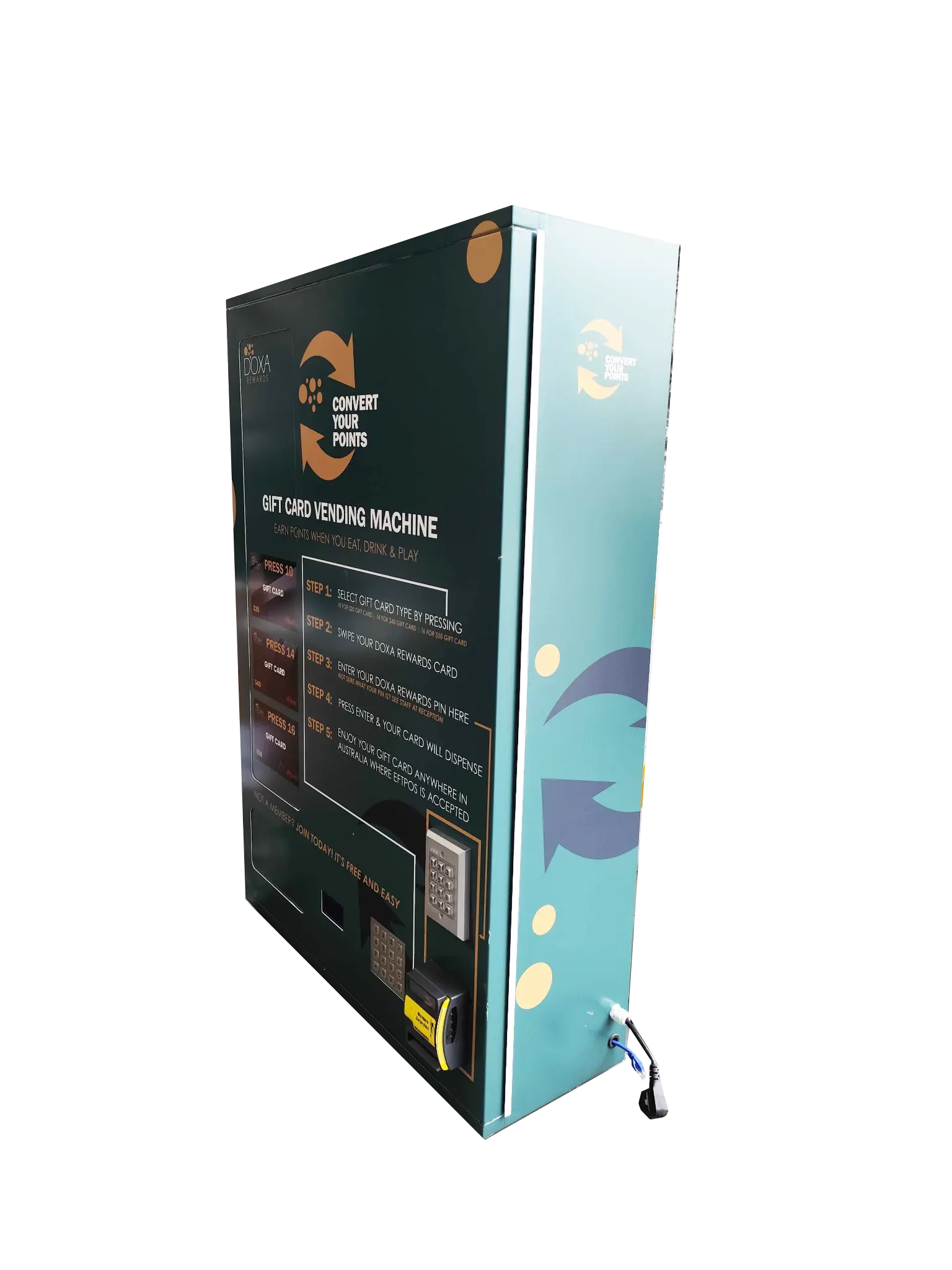
Why the wall is the useful surface
The request turns up repeatedly and in almost the same words: a small wall-mounted vending machine — contactless compatible — doesn’t matter where it’s made, I just can’t find one.
A search for a wall vending machine for sale, or for wall-mounted vending machines for sale, comes up short because it is not really a catalogue product. The useful size of a wall-mount machine is set by what goes into it. A cabinet that suits a boxed test kit is the wrong cabinet for a foil-packed sachet, and a cabinet that suits either is the wrong cabinet for a pair of safety glasses. So the wall vending machines that exist are mostly the ones somebody had built, and the sensible way to buy one is to start from the product and the position rather than from a model number.
This page covers where the form factor wins, what “compact” actually constrains, what mounting and site access it needs, what these machines dispense, and which payment options fit inside a shallow cabinet. The model specification is on the compact wall-mount machine page; the wider range of floor-standing models is on vending machines.
Where wall-mount wins
| Position | Why the wall wins there |
|---|---|
| Washrooms and change rooms | There is no floor space to give, and the product — sanitary items, hygiene supplies — belongs at the point of need rather than at a service desk |
| Corridors, foyers and lift lobbies | Circulation space cannot be obstructed; a machine on the wall keeps the whole floor width clear |
| Clinics and waiting areas | A compact unit reads as fixed equipment rather than retail, and stays discreet in a clinical setting |
| Workshops and production bays | Consumables issued at the bay instead of at a central store, without losing floor area beside the machine or the bench |
| Campus buildings and student spaces | Distributed coverage across many buildings matters more than depth of range in any one of them |
| Saunas, libraries, community venues and other 24-hour spaces | Small footprint, low visual weight, and unattended operation in venues with no staff to run a counter |
| Sites where you need many positions, not one big machine | Several small machines close to users usually beat one large machine somebody has to walk to |
That last row is the one that changes procurement decisions. If the problem is access — people not bothering to walk to the store, or a service that only works if it is where the user already is — then the number of positions matters more than the capacity of any single unit, and a compact machine is what makes multiple positions affordable.
What “compact” actually constrains
A wall-mount machine is not a small floor-standing machine. Four things are genuinely different, and all four are cheaper to settle before the cabinet is designed.
Depth sets the pack size
Typical wall-mount units run in the region of 200-350 mm deep. That depth, divided by the depth of your pack, is how many units sit behind each selection. It is also the reason a bulky pack is a poor candidate: a machine that empties every few days costs more to service than it saves in floor space.
Send the packaging dimensions with the enquiry — width, height and depth of the pack as it will actually be loaded, in its shipping packaging, not the product inside it. Capacity is engineered from that number. On the free sanitary-product build, the client revised the product dimensions mid-build and the coils had to be re-pitched and re-sourced; it was recovered inside 48 hours, but the cheaper version of that story is measuring the pack first.
Selections trade against facings
A compact cabinet carries 6 to 30 or more coil selections. Every extra selection is one more product in the range and one less column of depth behind the products already there. Deciding how wide the range needs to be is a service-interval question, and it is worth doing with real consumption numbers rather than by filling the grid. Dispense reliability and stockout prevention sets out how facings and par levels are allocated from measured consumption.
Coil pitch is configured per position, not per machine
Mixed product sizes in one compact cabinet are normal and supported: narrow coils in the region of 40-50 mm for items like condom packets alongside wider coils around 70-90 mm for boxed test kits, in the same machine. Pitch is chosen per selection. The available coil forms are on coil options, and the planogram configurator lets you lay out the selections and pitches yourself before requesting a quotation.
Payment hardware has to be designed in
A card terminal, its mounting, its cabling and — on cellular devices — its antenna all have to fit inside a shallow cabinet and be reachable for service. On a floor-standing machine this is barely a constraint. On a wall-mount it is a design input. Decide the payment method before the cabinet, not after.
Mounting, access and the site survey
Mounting
The mounting method is kept deliberately generic — suitable for both brick and drywall — so that one machine specification works across very different venues, and we supply the engineering drawings for the mounting backplate with the machine. An optional floor stand is available where a wall is unavailable or unsuitable.
The physical installation is carried out locally, by your installer or contractor (or, in some regions, a local distributor), using those drawings and our installation guidance. That is how the Australian public-health deployments were done, and it is the arrangement to plan for: we supply the machine and the drawings, your side supplies the labour, the fixings appropriate to the substrate, and the local knowledge of what is behind the wall.
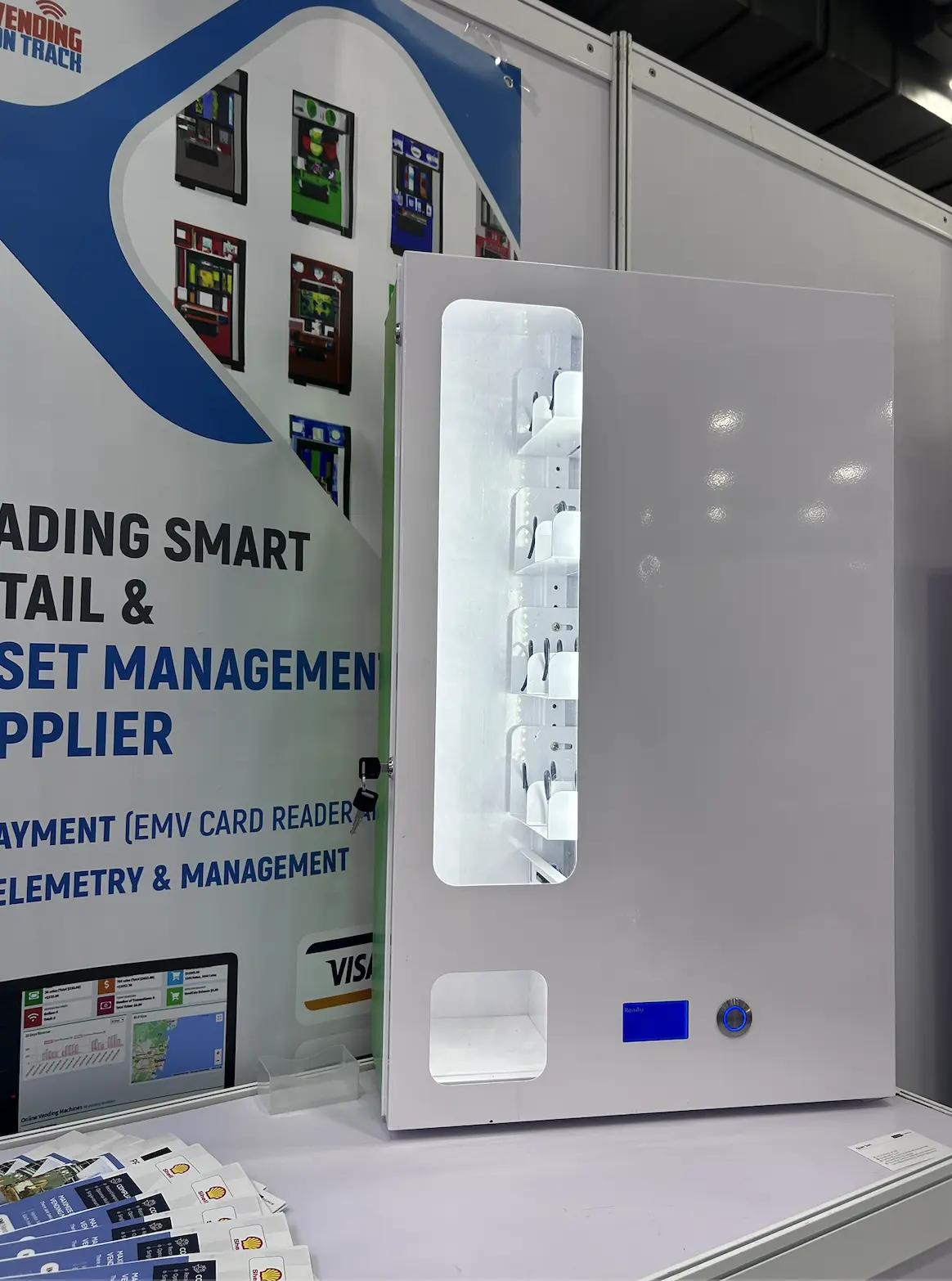
Loaded weight is on the specification issued with your quotation. It depends on the cabinet you specify and what you load into it, so take that figure to the installer rather than a generic one.
What to confirm at each position before drawings are issued
- Substrate and condition — brick, block, drywall, stud spacing, and whether the wall carries structure or services at the fixing points.
- Mounting height — set by the accessibility standard that applies in your jurisdiction. You specify the height; we build to it. Our period-product dispensing guide references the ADA reach range of 15-48 inches from the floor as the US example, but the applicable rule is local and it is yours to determine. We do not certify compliance with any national access standard on your behalf.
- Power at the position — a socket or spur within reach, on the destination market’s supply. What to specify is on power and compliance.
- Network at the position — Wi-Fi coverage or usable cellular signal for the 4G module. Signal inside a washroom or a basement corridor is not the signal in the lobby; check it where the machine will actually be.
- Clearance — room for the door to open fully for restocking, and circulation space in front for a user to stand and collect from the delivery bin.
- Environment — humidity, cleaning regime, temperature and whether the position is outdoor-adjacent. State these at enquiry; they affect the specification.
- Service access — who restocks, when they can get in, and whether the position is inside a space that locks after hours.
Points 4 and 7 are the two most often skipped, and they are the two that decide whether the deployment is pleasant to run a year later.
What these machines dispense
Compact machines are usually specified for small, boxed or packeted items with predictable dimensions. The categories we have built for:
| Category | Typical products |
|---|---|
| Sanitary and hygiene | Pads, tampons, pantyliners, personal hygiene items |
| Sexual health | Condoms (single foil packets and multi-packs), lubricant sachets |
| Test kits | HIV self-test kits, rapid antigen tests, other boxed self-test kits |
| Harm reduction | Naloxone, breathalyser tubes, test strips, sterile equipment and disposal containers |
| PPE, small items | Safety glasses, earplugs, gloves and other packeted consumables at the point of use |
| Small consumables and parts | Blades, inserts, batteries, fasteners and similar packeted items issued at a bay |
The health categories are covered in depth on public health vending, including the coil setups used for each. Where the item is PPE issued to a named worker against an entitlement rather than sold, the control model is the one described on PPE cost control and quota-based issue — the form factor changes, the entitlement logic does not.
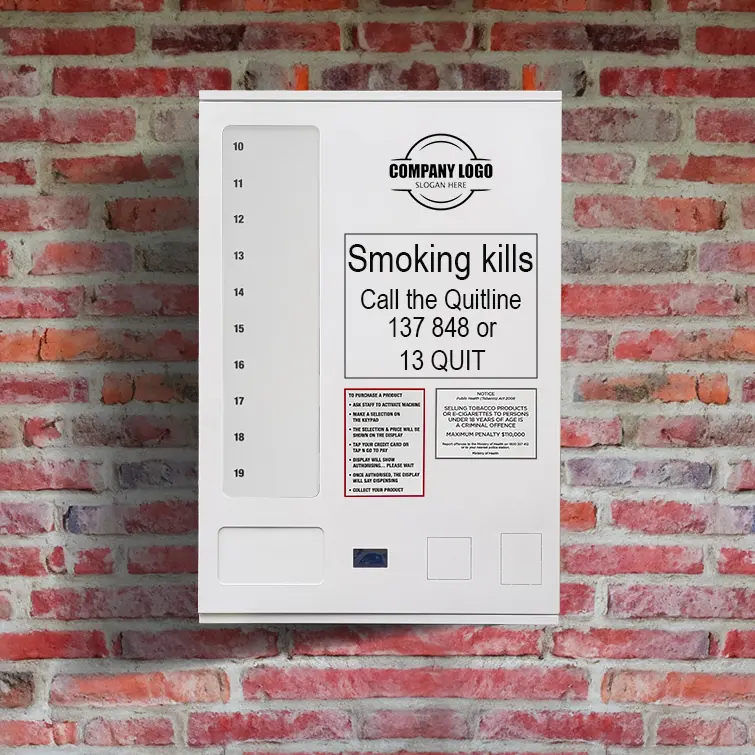
Dispensing is coil-driven into a secure delivery bin. Users have no access to the stock behind the glass, which is what makes these units usable for controlled products in unattended positions.
Payment options on a compact machine
Everything on the payments compatibility matrix is available in principle; the difference on a wall-mount is that the depth constraint above decides what physically fits. In practice these are the options that come up:
| Option | Needs a reader? | Typical use on a compact machine |
|---|---|---|
| Free vend | No | Employer-supplied PPE, publicly funded health programs — the control is entitlement, not price |
| QR code on screen | No | WeChat Pay, Alipay and other QR wallets; the customer’s phone does the work a reader would |
| SMS or web code release | No | The user registers on a portal beforehand and enters a code at the machine — the pattern used by the HIV self-test programs |
| RFID badge or PIN | Reader, but shallow | Issue against a worker account with quotas, recorded to the named worker |
| MDB cashless terminal | Yes | Contactless cards and wallets via VendCoin, Nayax, Cantaloupe or another MDB device — fit and power checked at quotation |
| Coin or note acceptance | Yes, and it is bulky | Possible, but cash hardware and a cash box compete directly with product depth in a shallow cabinet |
Two points worth stating plainly, because they are the ones buyers get caught by:
- Item-level sales data does not come from the payment terminal. The machine composes its own order record — items, quantities, machine, location, time, order state, receipt ID — and sends it to the cloud dashboard regardless of how the customer paid. This is the “I can’t see which product was sold when it was paid with card” problem, and it is answered in full on the payments page.
- Whether a specific terminal will work is answered at quotation, not in a brochure. Send us the make and model plus the vendor’s MDB documentation, and tell us the destination country — we check the MDB interface and revision and the physical fit; your processor confirms it is licensed to acquire in that market.
Screen or no screen
| Screen-free (QR only) | With a touchscreen | |
|---|---|---|
| Interaction | Happens on the user’s own phone before they reach the machine | Happens at the machine |
| Best for | Code-based and registration-gated dispensing, single-purpose machines | Multi-selection ranges, multi-language sites, eligibility questionnaires, advertising |
| Cost and failure surface | Lower on both | Higher on both |
| Revenue role | None | Can carry the business model — advertising, campaigns, promotion |
Screen sizes from 7 inches to 32 inches have been supplied. The 32-inch build exists for a specific reason: on the free sanitary-product program, on-screen advertising is what funds free products for the user, so the screen is the revenue engine rather than a nicety. If nothing in your model depends on the screen, a screen-free machine is a legitimate and cheaper answer.
Where wall-mount is the wrong answer
Saying this plainly saves everybody a quotation cycle.
- Bulky or heavy products. A shallow cabinet holds few units of a large pack. If the service interval comes out impractical, the honest answer is a floor-standing machine or a locker system.
- Wide ranges. Thirty-odd selections is a ceiling, not a target. A tool crib with hundreds of line items needs a tool and parts vending machine, not several wall-mount units.
- Refrigerated or heated product. Compact wall-mount units in this family are ambient. Temperature-controlled requirements change the machine entirely.
- Returnable equipment. Issue-and-return workflows belong in locker cells that can accept an item back, covered on customised lockers.
- Walls that cannot take it. Partition walls, heritage fabric, glazing and services-dense walls are all real constraints. The floor stand exists for these positions.
- High-volume retail. If the position turns over enough to justify a full-size machine, buy the full-size machine — cost per selection and cost per service visit both favour it.
Proven deployments
These are already-delivered programs, and they are the reason the form factor is well understood here rather than theoretical.
| Program | Scale | What the wall-mount form factor made possible |
|---|---|---|
| HIVConnect | Six Australian states and territories | Free HIV self-test kits placed in non-clinical positions — campuses, community venues, public spaces — where a full-size machine would not be accepted |
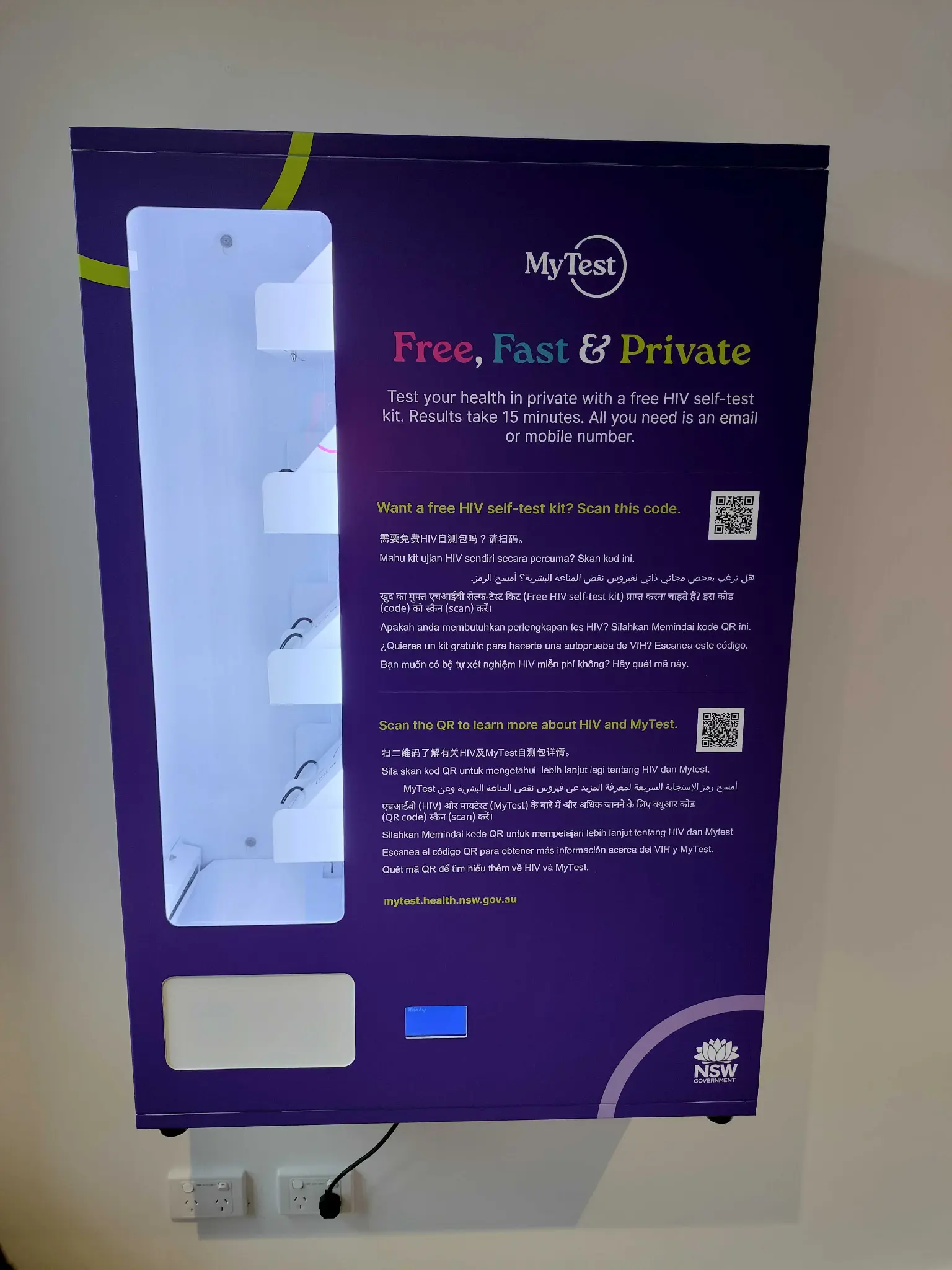
| MyTest | 16 NSW locations | One machine specification working across university campuses, community health centres, a public library, saunas and a clinic |
| Free sanitary products | Five prototypes, then a 50-unit order | 32-inch advertising touchscreens funding free products at the point of use, with a cloud questionnaire gating eligibility |
All three run on cloud platforms built by our Australian software partner, Vending on Track, handling registration, code verification, per-user quotas and real-time inventory across sites. The build story for the sanitary-product program, including costs and the full timeline, is on the blog.
What to send with an enquiry
- Product packaging dimensions — width, height and depth of each pack as loaded, in its shipping packaging.
- The range — how many distinct products, and roughly what share of demand each takes.
- Expected consumption — units per position per week, even approximately. This sets the service interval and therefore the cabinet.
- Number of positions and what each one is: washroom, corridor, clinic, workshop bay, campus building.
- How the user is authorised — paying customer, registered user with a code, or a worker against an entitlement.
- Payment method, and if it is a card terminal, the make and model plus the vendor’s MDB documentation.
- Destination country — for supply voltage, plug pattern and the applicable certification marks.
- Screen or screen-free, and whether the screen has a job to do beyond the transaction.
- Site conditions at the positions — substrate, power, network signal, environment, service access.
With items 1, 3 and 4 we can tell you whether a wall-mount is the right form factor at all, which is the question worth answering first.
Questions to send any supplier
Useful whoever you are buying from.
- Is this a purpose-designed wall-mount cabinet, or a shortened floor-standing machine?
- How many units per selection will it hold with my pack dimensions?
- Do you supply engineering drawings for the mounting backplate, and does the mounting suit both brick and drywall?
- What is the loaded weight, and what does your drawing assume about the substrate?
- Is the installation included, or is it local? If local, what guidance comes with the machine?
- Can coil pitch differ per selection so I can mix pack sizes in one machine?
- Will a card terminal physically fit, and where does its antenna sit?
- Does the sales report show the product on a card transaction, or only the amount?
- Can the machine run without a screen, and what changes in the user experience if it does?
- Who supplies spare coils, motors and locks in three years, and how are they identified and ordered?
Question 8 is on the list for the reason set out on the payments page; question 10 is on it for the reason set out on spare parts and after-sales support. Both are covered more fully in the manufacturer vetting checklist.
How KioskForce answers each point
| Point | Our answer |
|---|---|
| Form factor | Purpose-designed wall-mount cabinet; typical units around 400-600 mm (W) x 200-350 mm (D) x 600-900 mm (H), built to your specification |
| Selections | 6 to 30 or more coil selections, with pitch configurable per selection |
| Capacity | Engineered from your product packaging dimensions and expected service interval, stated on the quotation |
| Mounting | Generic brick-and-drywall backplate with engineering drawings supplied; optional floor stand |
| Installation | Optional; carried out locally by your contractor or, in some regions, a local distributor, with our drawings and installation guidance; we do not send installers |
| Screen | Optional, 7 to 32 inches, or screen-free with QR code only |
| Payment | Free vend, QR code, SMS code release, RFID badge or PIN, and MDB cashless terminals including VendCoin, Nayax and Cantaloupe |
| Sales data | Item-level order records come from the machine’s own telemetry, not from the payment terminal |
| Connectivity | 4G cellular or Wi-Fi, with real-time stock levels and low-stock alerts on the cloud dashboard |
| Lighting and branding | Internal LED illumination, optional external signage panel, branded exterior panels and screen UI |
| Indicative price | USD 800 to USD 1,500 per unit for the compact wall-mount model, configuration-dependent |
| MOQ and lead time | One unit for standard models, around ten for a full custom design; 4-12 weeks depending on the extent of customisation |
| Warranty | 12 months standard on manufacturing defects; third-party payment devices follow their own vendor’s terms |
| Track record | Delivered for HIVConnect across six Australian states, MyTest at 16 NSW locations, and a 50-unit free sanitary-product rollout |
Hardware and software are both designed in-house, so the cabinet, the coil layout, the payment method and the reporting are specified together. See customisation for how a configuration is agreed.
Wall-mount vending guides
Guides on price, installation, dimensions, accessibility, washrooms, hotels, gyms, security and how wall-mount compares with floor-standing machines.
- ADA-Compliant Vending Machines: Reach, Protrusion and Mounting — ADA-compliant vending machines: what the 2010 ADA Standards require (sections 228, 305, 307, 308, 309), and how to mount a wall vending machine to meet them.
- Bathroom Vending Machines: What Sells, Where and How — Bathroom vending machines for period products, condoms and hygiene items: what sells, free vs paid, humidity and IP ratings, hygiene, height and placement.
- Hotel Vending Machines: Amenities, Room Charge and Placement — Hotel vending machines for forgotten items and amenities: what to stock, card vs room charge, wall-mount units on guest floors, corridor rules and cost.
- How to Install a Wall-Mounted Vending Machine — How to install a wall-mounted vending machine: identify the wall, choose fixings and backing for the load, set the height, run power and data, and who does it.
- Mini and Small Vending Machines: What Fits Where — Mini vending machines compared: countertop, wall-mount and slim cabinets, what each holds, where each fits, what they cost, and when a small machine won't pay.
- Vandal-Resistant Vending Machines for Unattended Sites — Vandal-resistant vending machines for unattended sites: steel, locks, glass vs solid fronts, fixings, door alerts, cages, and why going cashless matters most.
- Vending Machines for Gyms: What Sells and Which Machine Fits — Gym vending machines: what sells (drinks, protein, supplements, accessories), when you need a fridge, member-card payment, placement and the supplement rules.
- Wall-Mounted Vending Machine Dimensions and Capacity — Wall-mounted vending machine dimensions: typically 400–600 mm wide, 200–350 mm deep, 600–900 mm high. How depth, coil pitch and screen size set capacity.
- Wall-Mounted Vending Machine Prices: What Drives the Cost — Wall-mounted vending machine prices: our compact wall-mount runs USD 800–1,500 per unit. What moves the price, what landed cost adds and what it costs to run.
- Wall-Mounted vs Floor-Standing Vending Machines — Wall-mounted vs floor-standing vending machines compared: capacity, footprint, cost, refrigeration, payment, security, restocking and ADA access.
Related reading
- Compact wall-mount vending machines — the model specification and standard configuration options.
- Vending machines — the full range of models, including floor-standing and industrial.
- Public health vending — test kits, naloxone, sexual health and hygiene products, with coil setups per category.
- Age-verified vending — the verification approaches available when the product is age-restricted, including screen-free code release.
- Payments — the processor and capability matrix, and why item-level sales data comes from the machine rather than the terminal.
- Coil options and the planogram configurator — checking product fit and laying out selections before you request a quotation.
- Dispense reliability and stockout prevention — facings, par levels and why vends fail.
- Power and compliance — supply voltage, plug pattern and certification marks by destination market.
- Shipping and landed cost — Incoterms, crating and what the machine price does not include.
- Spare parts and after-sales support — coils, motors, locks and boards, years after installation.
- How to vet a vending machine manufacturer — before you commit to a supplier.
- How to dispense period pads and tampons — product mix, coil sizing and placement for the most common compact application.
Get started
Send the packaging dimensions, the range, the expected consumption per position and what each position looks like. We will tell you whether a wall-mount is the right form factor, how many units per selection it will hold with your pack, and what the cabinet needs to be.
Project brief · 60 seconds
What are we building together?
Three quick steps. Your brief goes straight to the engineers who design, build and support KioskForce systems.

