
The short answer
A medicine vending machine (or any vending machine for medicine) is a locked cabinet that releases a health product only when a rule you have set is satisfied — a code, a badge, a staff authorisation, a quota not yet used up — and records that it did so. The hardware is a solved problem. The hard part is the question that sits in front of it: is this product allowed to be supplied this way, at this site, in this jurisdiction?
That question does not have one answer. Medicines are scheduled differently in every jurisdiction: the same product can be off the shelf in one country, pharmacist-only in a second and prescription-only in a third, and rules on who may supply, from what premises, at what hours, with what storage and with what record vary just as much. So this page does not tell you what is legal where you are. It describes the products that are typically involved, the controls a machine can enforce, and how we build to the requirement you bring.
We build to the compliance requirement you state, and we do not certify that a machine meets any medicines, pharmacy or therapeutic-goods law. We do not claim that our machines are approved for any category of medicine. The same position is set out for age-restricted products on age-verified vending.
Settle the regulatory question first
Before hardware, before cabinet size, before the quotation, get an answer from your regulator, pharmacy board, health department or legal adviser:
For these products, at this type of site, in this jurisdiction — may they be supplied from a machine at all, who must authorise each release, how must they be stored, and what must be recorded?
The answer usually places each product in one of three groups, and the group decides the architecture.
| Group | Typical products | What it usually means for the machine |
|---|---|---|
| A. Health products many markets already vend | HIV self-test kits, rapid antigen tests, condoms and lubricant (condom vending machine guide), sanitary products | Unattended dispensing is common. Controls are about fair distribution and reporting: codes, per-person quotas, usage data |
| B. Over-the-counter medicines | Products sold without a pharmacist in your jurisdiction | Possible where your local rules allow it. Those rules may limit the product list, pack size, site type, hours or labelling — find out which before specifying |
| C. Pharmacist-only and prescription medicines | Anything requiring an authorised person to supply | Usually not an unattended shop. The realistic shapes are a staff-authorised release or a pickup locker for a prepared order |
The group a product sits in is not ours to decide, and a supplier who assigns it for you is telling you something they cannot know. If your rule changes after installation, release methods can be enabled or disabled per machine from the cloud dashboard — but whether the machine should be trading at all is still your regulator’s call.
What we have actually delivered (Group A)
The evidence here is health products, not scheduled medicines, and it is worth being precise about that.
| Program | What the machines dispense | How release is controlled |
|---|---|---|
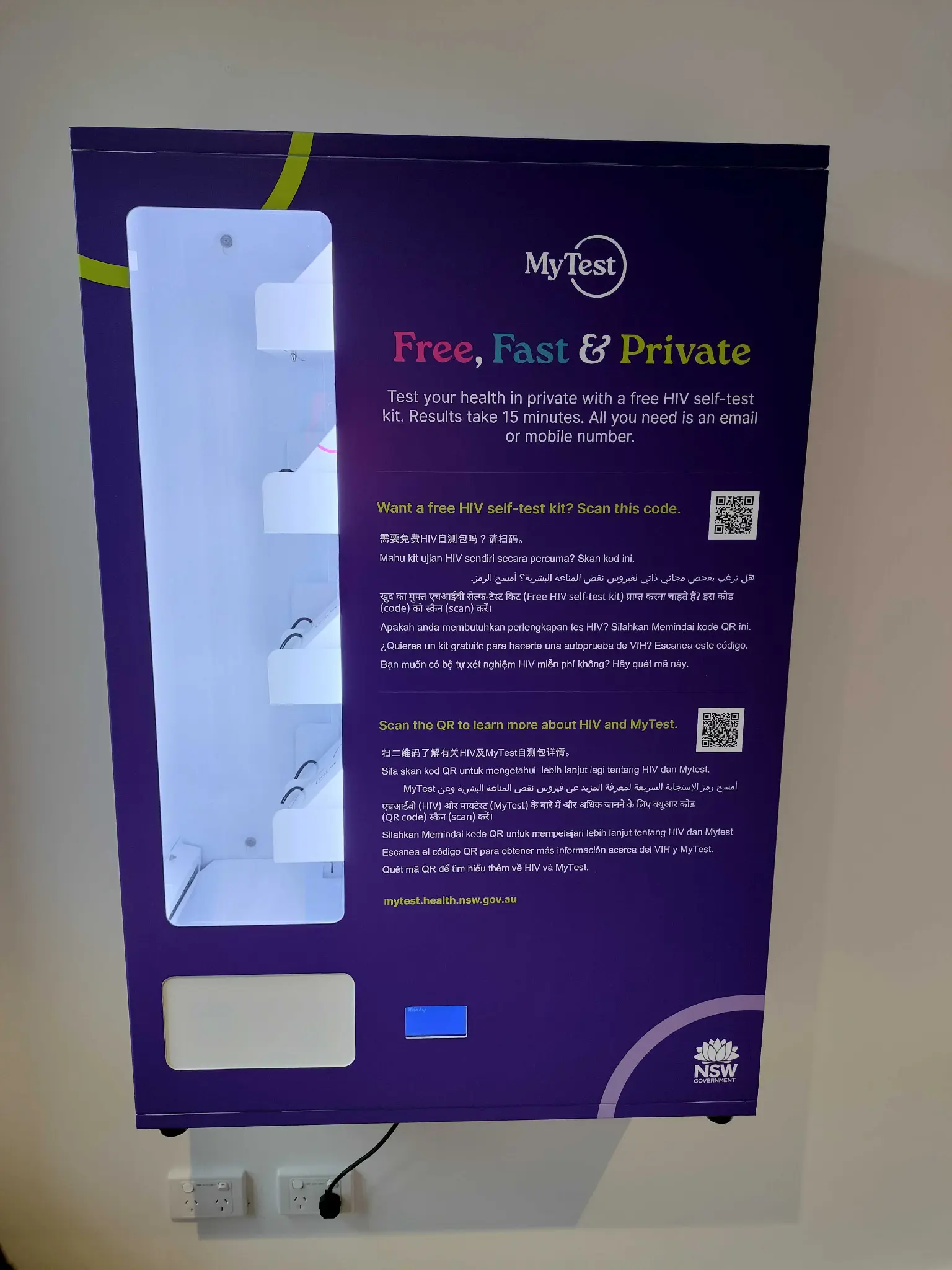
| HIVConnect | Free HIV self-test kits, in a federally funded Australian pilot across six states and territories | User registers on the program website, receives an SMS code, scans or enters it at the machine; per-user quotas; no personal data on the machine |
| MyTest | Free HIV self-test kits (each with condoms and lubricant sachets), at 16 locations across NSW | Registration by mobile number or email; up to 4 free kits per person per month, enforced by the cloud platform |
| Free sanitary products | Free feminine hygiene products, funded by on-screen advertising | A cloud questionnaire gates free dispensing; five prototypes, then a 50-unit order |
| Free vends with a monthly quota | Free kits issued by a health agency | Testers sign up once with email or mobile, receive a reusable access code, and draw against a monthly quota |
We manufactured the wall-mount machines; the cloud platforms handling registration, code verification, quotas and inventory were built by our Australian software partner, Vending on Track. The full range of public health products and the coil setups used for each is on public health vending.
Where medicine and health vending is used
Medical vending machines turn up in a handful of settings, and each one shapes the cabinet differently.
| Setting | What it is for | Typical shape |
|---|---|---|
| Hospitals after hours | Staff and visitor access to supplies when the store, shop or pharmacy counter is closed | Badge-access vending at the point of care; locker cells where staff place prepared items for later collection |
| Workplaces and remote sites | First-aid and health consumables issued to named workers, often free against an entitlement | RFID badge or PIN, per-worker quotas, the same control model as PPE quota-based issue |
| University campuses | Discreet, free access to sexual health and hygiene products in student spaces | Compact wall-mount, code release, per-person quota |
| Public health programs | Free test kits and health products in community venues, clinics, libraries and other non-clinical positions | Wall-mount, code release, quota, usage reporting for funders |
| Pharmacies and clinics | Collection of a prepared order outside counter hours, or controlled release while staff are present | Pickup locker or staff-authorised release |
The hospital supply side — PPE, consumables, kiosks and smart lockers by department — is covered on healthcare.
The controls that matter
A machine cannot make a supply lawful. What it can do is enforce, reliably and on the record, the controls your rule asks for.
Release control
- Controlled dispensing, not self-selection. Items are pushed by a coil into a secure delivery bin, or released from a locker cell that opens only for the authorised transaction. The user never reaches the stock.
- Code release. The user is checked off the machine — on a program website, by SMS or by QR — and arrives with a code the machine accepts. This is how the HIV self-test programs work, and it runs on screen-free cabinets.
- Badge or PIN. For staff and known populations, release is against an RFID card or PIN, recorded to the account.
- External validation. The machine asks your own system whether to release, and does what it is told — the pattern we built for a business group validating against its employee database (SMS2Vend with external validation). If the authorisation already exists in a pharmacy or patient system, the machine should ask it rather than reimplement it.
- Staff-authorised release. Stock stays locked and a person authorises each vend from an attendant interface. The approaches, and their failure behaviour, are set out on age-verified vending.
Quotas and limits
Per-transaction limits cap units per vend; per-person quotas over a period extend that across visits. The MyTest program runs up to 4 free kits per person per month, enforced in the cloud. The limit you need is a policy decision — state it at enquiry and it is built in.
Records
Every dispense writes the same order record: items, quantities, machine, location, time, order state and receipt ID. What varies is how much identity is attached to it. Our public health builds attach a token rather than a name — registration happens on a separate portal, and the machine never holds personal data. If your rule requires the record to name the recipient, the authorising person or both, say so and it is specified that way. Who can read the record, and how long it is kept, are set by your privacy regime and written into the specification.
Temperature
The floor-standing KF10X22, BG10X10 and KF6X10 are available in refrigerated (R290 or R134a) or ambient configurations; compact wall-mount units are ambient. Optional temperature monitoring with alerts can be fitted, and the cloud backend on our public health builds can capture temperature logs alongside dispense data. State the storage range your product requires and how temperature must be recorded. If your rule requires a validated cold chain, that validation belongs to your quality system and your regulator — we build the cabinet and monitoring you specify, and discuss the validation requirement before quoting rather than claiming a certification of our own.
Stock and expiry
The cloud dashboard shows live stock levels with low-stock alerts, and staff can monitor stock and expiry dates through the restocking interface. If your rule requires batch or lot records for each dispense, raise it at enquiry so it is scoped into the software specification rather than assumed.
Siting and trading hours
Release methods can be enabled and disabled per machine from the cloud dashboard, so a machine can be permitted to release only in staffed hours and refuse outside them — or taken out of service quickly if a site’s status changes. Where the machine is placed, and who can see it, is part of the compliance conversation, not a detail for afterwards.
Pickup lockers and staff-authorised release (Group C)
Where an authorised person must supply the medicine, the machine stops being a shop and becomes stock security plus a record. Two shapes fit:
- Pickup locker. A pharmacist or clinician prepares and checks the order, places it in a cell, and the recipient collects it with a code, QR scan or badge — including outside counter hours. Our locker platform already runs this click-and-collect pattern, with dual authentication (PIN and card) available for pharmaceutical lockers. See smart lockers and customised lockers; a kiosk with locker cells, such as the K180-6C, adds a 21.5-inch touchscreen in front of the cells.
- Staff-authorised release. Stock sits behind a locked door in a vending cabinet, and each release needs a staff authorisation, given after whatever check your rule requires.
Both are architecture options, not compliance guarantees. Whether either one is permitted for your product is for your regulator to say.
Payment and free-vend options
| Option | Typical use in health vending |
|---|---|
| Free vend against a code | Publicly funded programs — the control is eligibility and quota, not price |
| Free vend against a badge or PIN | Workplaces and hospitals issuing to staff against an entitlement |
| Questionnaire-gated free vend | Programs that need usage or eligibility data in exchange for a free product, completed on the user’s phone |
| QR code wallets | WeChat Pay, Alipay and other QR payments, with no reader on the machine |
| MDB cashless terminal | Contactless cards and wallets through Vending on Track VendCoin, Nayax, Cantaloupe or another MDB device |
Item-level sales data comes from the machine’s own order record, not from the card terminal. The processor matrix and the reasons are on payments.
Where a medicine vending machine is the wrong answer
- Where the product cannot be supplied from a machine in your jurisdiction. No machine fixes a prohibition. Ask this first — it is the cheapest question.
- Where the rule requires a consultation at the moment of supply. If a pharmacist must speak to the patient, a locker can hold the order but cannot replace the conversation.
- Where strict cold-chain validation is required and your quality system has not defined it. Settle the validation requirement before choosing the cabinet.
- Where volume is a handful of items a week. A staffed counter is cheaper than an integration project.
- Where a wide, frequently changing range is needed. A vending cabinet holds a fixed number of selections; a pharmacy shelf it is not.
What to send with an enquiry
- The products and their packaging dimensions as loaded.
- The jurisdiction and site type — country, state or province, and whether the position is staffed, semi-staffed or unattended.
- The rule you must satisfy, in whatever form you have it — licence condition, regulator guidance, program protocol or tender clause — and which group (A, B or C above) your regulator places each product in.
- How users are authorised — code, badge, external system, or staff release.
- Limits — units per transaction and per person per period.
- What must be recorded, for how long, and who must be able to read it.
- Storage temperature range and how temperature must be monitored and logged.
- Payment model, or that supply is free.
- Expected volume per position and the number of positions.
The wall-mount guide covers the site survey for compact positions — power, network, mounting and clearance.
Questions to ask any supplier
- Which health products have your machines dispensed in a live deployment, and can you name the program?
- Do you claim your machine is approved or compliant for medicines in my jurisdiction — and on what basis?
- Where is the release decision made — on the machine, or by an external system — and what happens if that system is unreachable?
- How are per-person quotas enforced, and does that need personal data on the machine?
- What exactly does each dispense record contain, who can read it, and how is it deleted?
- Is the refrigerated cabinet’s temperature monitored and logged, and what alert is raised when it drifts?
- Can release methods and products be disabled remotely if a site’s status changes?
- Will you put the full specification — release, limits, records, temperature — in writing on the quotation?
Question 2 is the tell. The honest answer is no: the supplier builds to your requirement, and your regulator decides whether it is met.
How KioskForce answers each point
| Point | Our answer |
|---|---|
| Health deployments | HIVConnect across six Australian states and territories; MyTest at 16 NSW locations; a 50-unit free sanitary-product rollout; a free-kit program with monthly quotas for a health agency |
| Compliance position | We build to your stated requirement and write it on the quotation. We do not certify regulatory conformity or claim approval for any medicine category |
| Release methods | Code release (SMS, web, QR), RFID badge and PIN, external validation against your system, staff-authorised release, locker pickup |
| Quotas | Per-transaction and per-person-per-period limits, enforced in the cloud |
| Records | Items, quantities, machine, location, time, order state and receipt ID; identity attached only as your rule requires |
| Temperature | Refrigerated (R290 or R134a) or ambient on floor-standing models; compact wall-mount units are ambient |
| Hardware and software | Both designed in-house; machines built in our partner factories in China |
| Ordering | MOQ one unit for standard models, around ten for a full custom design; 4 to 12 weeks depending on customisation, with software scoped separately |
Medicine and health vending guides
Guides on what medicine vending is allowed where, OTC and pharmacy pickup, period products, naloxone, HIV self-tests, campus health, temperature control and cost.
- Are Medicine Vending Machines Legal? — Are medicine vending machines legal? Often yes for over-the-counter medicines with conditions, rarely for pharmacy-only or prescription drugs. Rules by country.
- Emergency Contraception Vending Machines on Campus — Emergency contraception vending machines on campus: the US rules behind Plan B in a machine, how universities run them, pricing, privacy and what else to stock.
- HIV Self-Test Vending Machines: How Programs Work — HIV test vending machines give out free self-test kits against a code, with quotas and no personal data on the machine. How programs run, and test accuracy.
- Health Vending Machines for Universities and Schools — Campus health vending machines: what students use them for, the laws behind them, free vs paid, privacy, quotas, placement and funding for universities.
- How Free-Vend Health Programs Work — How free vending machine health programs work: releasing items without collecting identity, per-person quotas, refills, reporting to funders and map finders.
- How Much Does a Medicine Vending Machine Cost? — Medicine vending machine cost: wall-mount from about USD 800, floor-standing from USD 1,200–2,100, plus the controls, software and running costs a program adds.
- Medical Vending Machines for Hospital and Clinic Supplies — Medical supply vending machines for hospitals: PPE, consumables and scrubs issued at the point of care against a staff badge, and how they differ from ADCs.
- Narcan and Naloxone Vending Machines: How Public-Health Programs Run Them — Naloxone (Narcan) vending machines: how programs run them free, the 2023 FDA OTC approvals, Australia's Take Home Naloxone program, storage limits and evidence.
- OTC Medicine Vending Machines: What to Stock and How to Run One — OTC medicine vending machine guide: what to stock, pack-size caps, labels, expiry rotation, recalls, temperature and placement, with rules that apply to each.
- Pharmacy Vending Machines and Prescription Pickup Lockers — Pharmacy vending machines for prescriptions are pickup lockers or licensed dispensing systems run by a pharmacy. How release works, state rules and what to log.
- Tampon and Period Product Vending Machines: Free vs Paid, Laws and Quotas — Tampon and period product vending machines: free-vend vs paid, laws requiring free products in Scotland, US states and Australia, and quotas that stop emptying.
- Temperature Control for Medicine Vending Machines — Temperature control for a medication vending machine: reading label storage ranges, ambient vs refrigerated cabinets, logging, excursions and power-loss plans.
Related reading
- Public health vending — test kits, harm reduction, sexual health and hygiene products, with coil setups per category.
- Healthcare — point-of-care supply vending, hospital kiosks and smart lockers.
- Age-verified vending — the verification approaches, staff release, records and failure behaviour, and the same position on compliance.
- Wall-mount and compact vending machines — the form factor behind the public health deployments.
- Smart lockers and customised lockers — pickup cells and dual authentication.
- Payments — processors, free vend and code release, and where item-level data comes from.
- Harm reduction vending machines — naloxone, syringe and test strip machines, controlled dispensing and on-screen questions, with their own guides.
- Harm reduction vending in government tenders — how governments use automated dispensing for harm reduction.
Get started
Tell us the products, the jurisdiction, the site type and the rule you have to satisfy. We will tell you whether a vending machine, a staff-authorised dispenser or a pickup locker is the right shape, and we will write the release method, limits, records and temperature specification into the quotation.
Project brief · 60 seconds
What are we building together?
Three quick steps. Your brief goes straight to the engineers who design, build and support KioskForce systems.

