
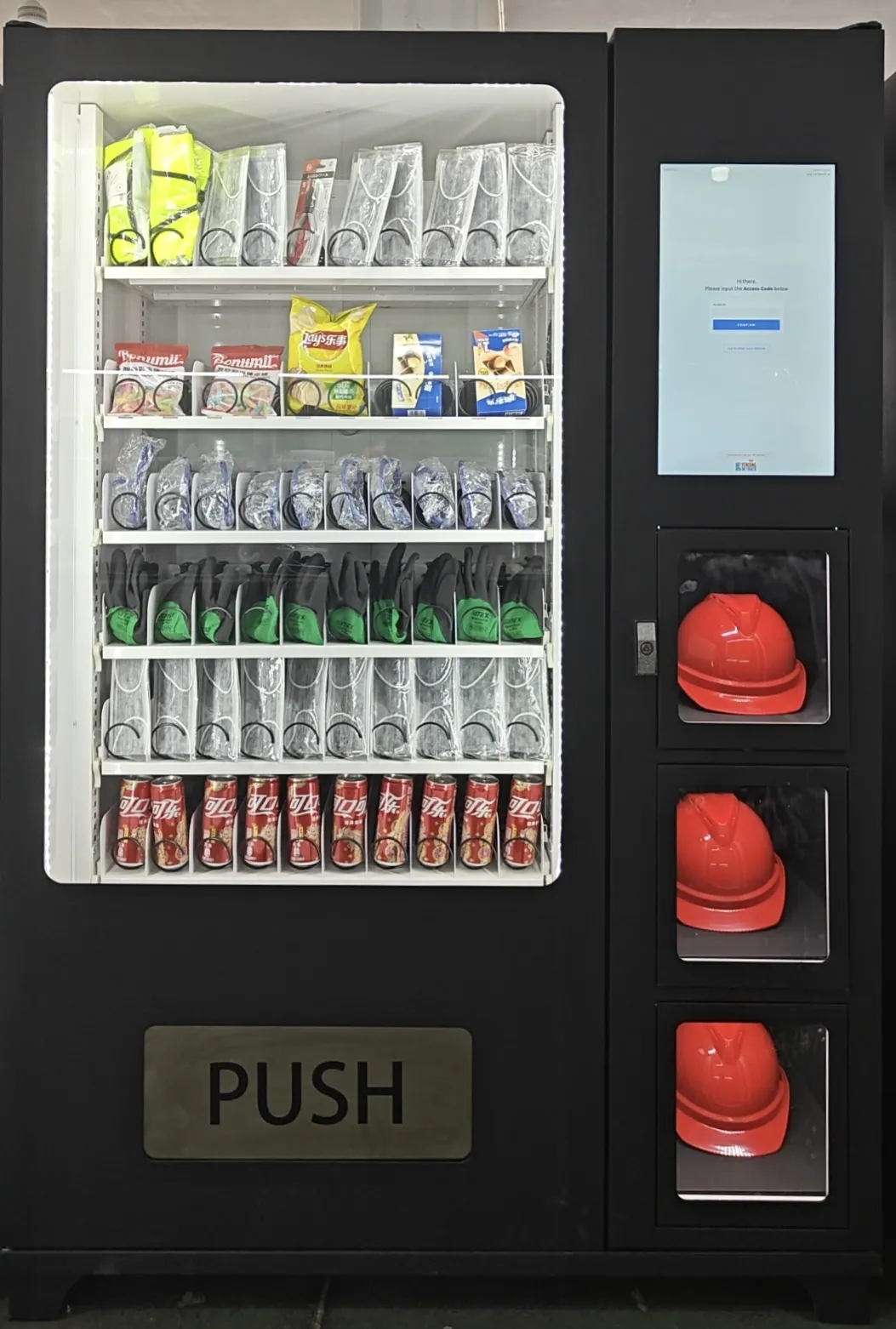
The Walk to the Storeroom Is Your Hidden Cost
Here’s a scenario that plays out thousands of times a day in factories worldwide:
A line worker runs out of gloves. They stop work, remove their PPE, walk 4 minutes to the central storeroom, sign out a new box, walk 4 minutes back, re-gown, and resume work. Eight minutes gone. For what? A box of gloves that costs $3.
Multiply that by 50 workers, 3 times per shift, 250 working days a year. That’s 5,000 hours of walking — over $175,000 in labor — spent fetching supplies. And that’s before you account for the production downtime while the line waits.
Point-of-use vending eliminates this waste. Put the supplies where the work happens, and the walk disappears.
How POU Vending Works
The POU Dispense Cycle
- Worker needs supplies — a box of nitrile gloves is empty, batteries for the torque wrench are dead, cleaning wipes are gone.
- Walk 10 steps to the POU station — the machine is mounted at the end of the production cell, in the maintenance bay, or at the assembly line.
- Badge in — tap RFID card or enter PIN. Access takes 2 seconds.
- Select items — the touchscreen shows only the supplies relevant to this station. No scrolling through irrelevant inventory.
- Dispense — coils rotate, items drop into the bin. Worker grabs them and returns to work. Total time: under 30 seconds.
- Data flows — the system logs: who took what, at which station, at what time. Consumption patterns emerge automatically.
What Makes POU Different from Central Storeroom Vending
The difference is location and specificity. A central tool crib vending machine stocks everything for everyone — 200+ SKUs, deep menus, choices to make. A POU station stocks only what this specific cell needs — 20–40 SKUs, 2-tap access, zero decision time.
What POU Vending Stations Dispense
| Category | Examples | Typical Replenishment Cycle | Dispensing Method |
|---|---|---|---|
| Hand Protection | Nitrile gloves, latex gloves, cut-resistant gloves, chemical gloves | Daily to weekly | Spiral coils |
| Cleaning & Wipes | Industrial wipes, microfiber cloths, alcohol pads, degreasing wipes | Daily to weekly | Medium trays |
| Batteries | AA, AAA, 9V, CR2032, rechargeable packs | Weekly | Small coils |
| Lubricants & Chemicals | Cutting oil, grease cartridges, anti-seize, thread locker | Weekly | Medium coils + trays |
| Sealants & Adhesives | Silicone sealant, epoxy, super glue, thread seal tape | Weekly to monthly | Small–medium coils |
| Safety Consumables | Earplugs, safety glasses, disposable respirators, face shields | Daily to weekly | Small coils |
| Stationery & Marking | Permanent markers, paint pens, labels, cable ties, tape | Weekly to monthly | Small coils |
| Small Hardware | Screws, nuts, washers, O-rings, gaskets, circlips | Weekly to monthly | Small coils |
| First Aid | Bandages, saline, burn cream, eye wash, sunscreen | Monthly | Small coils |
The Numbers: POU Vending ROI
For a manufacturing site with 100 production workers on single shift:
| Cost Category | Central Storeroom | POU Vending Stations | Annual Saving |
|---|---|---|---|
| Walking/retrieval time | 5,000 hrs/yr ($175,000) | 500 hrs/yr ($17,500) | $157,500 |
| Consumable waste (over-collection) | $45,000 | $34,000 (–25%) | $11,000 |
| Production stoppages (waiting for supplies) | $30,000 | $5,000 | $25,000 |
| Storeroom attendant | $50,000 | $15,000 (reduced hours) | $35,000 |
| Total | $300,000 | $71,500 | $228,500 |
Investment: 8 POU stations at ~$2,500 each (configured) = $20,000
Payback period: Under 5 weeks.
Strategic Placement: Where POU Stations Belong
| Location | What to Stock | Why It Works |
|---|---|---|
| Assembly line, every 8–12 stations | Gloves, wipes, markers, cable ties, small fasteners | Assembly workers need supplies 3–8 times per shift |
| Maintenance bay | Batteries, lubricants, sealants, cleaning supplies, shop towels | Maintenance techs burn 15–20% of their day fetching supplies |
| CNC machine cluster (every 5–8 machines) | Cutting oil, wipes, deburring tools, inserts, measuring tools | Operators need frequent resupply without leaving the machine zone |
| Quality inspection station | Gloves, wipes, calibration labels, markers, sample bags | Inspectors handle multiple products; supplies should be arm’s reach |
| Packaging & shipping | Tape, labels, markers, stretch wrap, box cutters, cable ties | High-frequency, low-cost consumables — the worst category to walk for |

POU Vending vs Traditional Approaches
| Central Storeroom Model | KioskForce POU Vending |
|---|---|
| Workers walk 5–10 minutes round-trip per supply run | Supplies are 10 steps from the workstation — 30-second access |
| One storeroom stocks everything — deep menus, decision fatigue | Each station stocks only what that cell needs — 20–40 SKUs, 2-tap access |
| “I’ll grab extra in case I run out” — chronic over-collection | Usage limits per worker per shift; system denies excess |
| Consumption data: “we ordered 500 boxes of gloves this year” | Consumption data: “Cell 3 uses 40% more gloves than Cell 2 — investigate” |
| Storeroom: locked at 5 PM, closed weekends | Self-service 24/7 — workers get supplies whenever they work |
| Stockouts discovered when someone complains | Automated reorder alerts per station, per SKU |
Keeping the Station Dispensing
A point-of-use station only earns its place if the item actually falls when an operator taps for it. The causes of a failed vend — coil pitch wrong for the pack, a worn spring end, no confirmation the item left the shelf — are mechanical, and each one is designed out rather than lived with. Dispense reliability and stockout prevention covers planogram fit checking before build, coil pitch chosen per product, optional per-cell weight sensing that verifies the dispense, and size-level par levels so a fast-moving glove size does not run out quietly.
Where the consumables belong to a specific job rather than a shift, the station can dispense against a work order or ticket reference instead of item by item — see work-order kitting and BOM dispensing.
Part of the KioskForce Industrial Vending Family
POU vending is one of three industrial vending categories KioskForce delivers on a single platform:
- PPE Vending — safety equipment dispensing with hybrid locker return
- Tool & Parts Vending — automated tool crib for cutting tools and parts
- Industrial vending suppliers compared — distributor VMI programmes vs OEM brands vs in-house builders, and when each is the better fit
Where a station needs to lend out equipment rather than consume it — torque tools, meters, radios or scanners — the equipment vending machines page covers locker-cell issue and return.
All three use the same hardware platform, the same access control, and the same cloud dashboard.
← Back to Industrial Vending Hub
Get Started
Tell us about your site — production layout, number of workers, and which consumables currently cost you the most in walking time and waste. We’ll map out a POU vending deployment that pays for itself in weeks.
Project brief · 60 seconds
What are we building together?
Three quick steps. Your brief goes straight to the engineers who design, build and support KioskForce systems.

