
Book Vending Machine Tokens vs QR Codes: What Should a School Use in 2026?
Most US school book vending machines run on physical tokens that staff hand out for reading goals or positive behaviour, usually inside the school’s PBIS framework. Tokens are simple, but they can’t limit a book to an age group, can’t be cancelled when lost, and record nothing. QR reward codes keep the same moment, the child choosing a book, and add reading levels, teacher and parent book lists, printable cards, online purchase by parents and term reports. The machine can take both. The deciding question is not tokens or codes: it is how the school will fund the books, which a published example puts at about US$1,000 a year for one machine.
A book vending machine in a school is a reward, not a shop.
A student meets a goal, gets a token, drops it in and picks a book to keep. That moment, choosing, is why schools buy them.
The token is the old part. Here’s what changes when it becomes a QR code.
How school book vending works today
Most US school programs follow the same pattern. Staff hand out tokens for reading minutes, attendance or a positive behaviour referral. The student inserts the token, chooses a title and takes it home.
The programs usually sit inside Positive Behavioral Interventions and Supports (PBIS). The Center on PBIS lists “encouraging and acknowledging expected behavior” among its core Tier 1 practices. A book machine is one way to acknowledge it.
The costs are public. A fully funded DonorsChoose project at a Houston middle school listed the machine at US$4,295, picture-book trays at US$250 and tokens at US$50, for US$6,222.26 in total. Bastrop ISD told KUT its machine cost about US$5,000 and that it spends about US$1,000 a year on books.
What a token can’t do
- It can’t tell ages apart. Any token buys any book. In a K–8 school, the picture books go to whoever gets there first.
- It can’t be cancelled. A lost token works for whoever finds it.
- It can’t expire. Last year’s tokens empty this year’s stock.
- It records nothing. The school can’t tell a funder how many students it reached or which books they chose.
- Parents can’t buy one. Family money for books has to go through the PTA.
What a QR reward code adds
A QR reward code is a printed card worth one book. KioskForce school book vending machines accept codes managed from the KioskForce School Portal. Each feature has its own guide:
- QR reward codes: single use, expiry, cancel and reprint, and an automatic return if the book doesn’t drop.
- Reading levels: tag each title K–2, 3–5 or 6–8, so a code shows only books at its level.
- Book lists: teachers and parents narrow a code to titles they pick. The child still chooses.
- Printable QR reward cards: a class batch, nine cards to a Letter page, handed out like tokens.
- Parents buy codes online: packs at a price the school sets, with a record of what the child chose.
- School Portal dashboard: books per week by level, codes outstanding, students reached and a refill list.
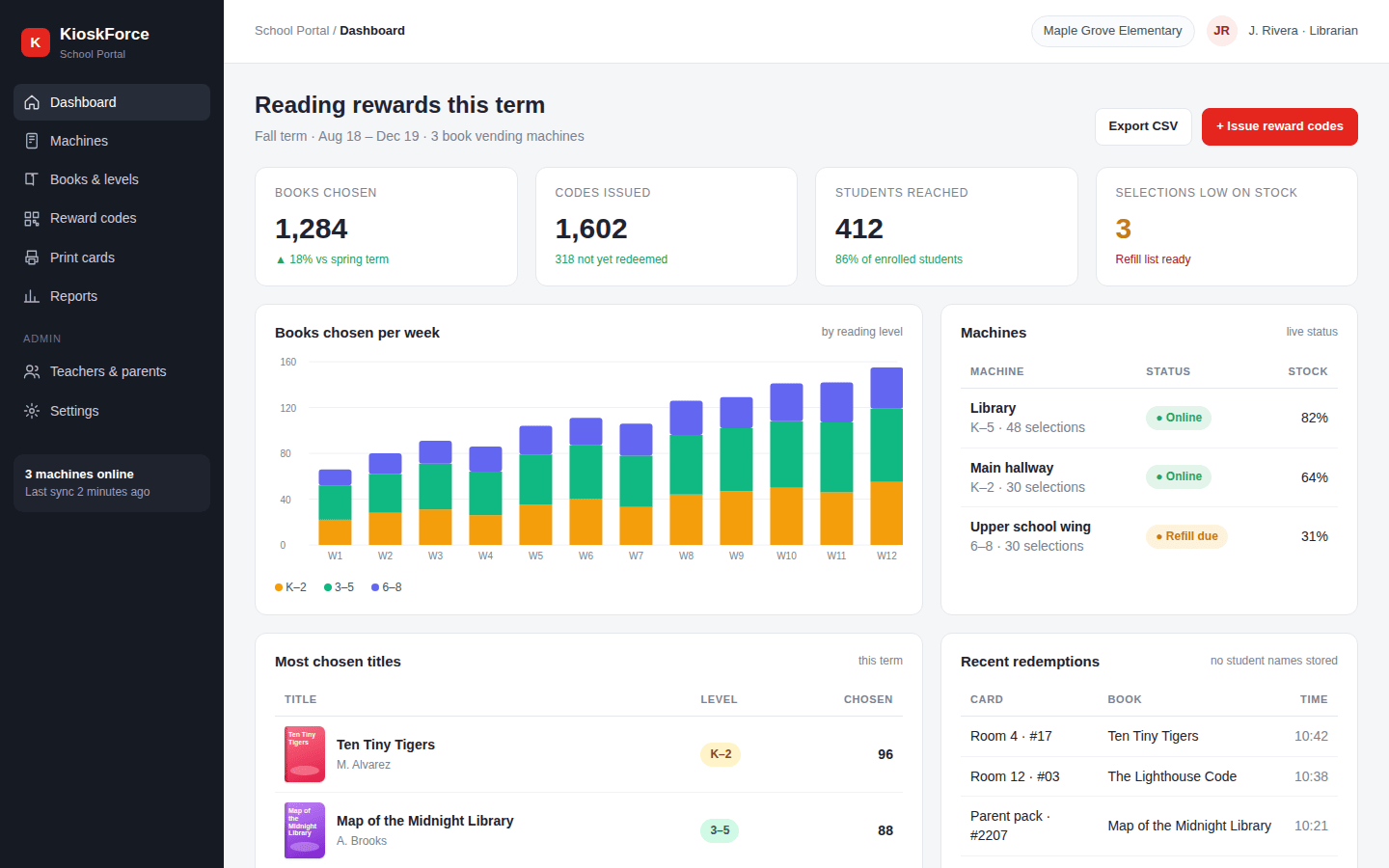 The School Portal dashboard. Sample school and data.
Tokens or codes: a quick comparison
| Token | QR reward code | |
|---|---|---|
| Limit to an age group | No | Yes, by reading level |
| Limit to chosen titles | No | Yes, by book list |
| Lost card | Still works | Cancelled, refused at the machine |
| Expiry | None | Optional |
| Parents can buy | No | Yes |
| Reports | None | Every redemption, by class and card |
| Best for | The youngest children, who like holding a coin | Levels, parent purchase and reporting |
A school doesn’t have to choose. The machine can take both, so a kindergarten class can keep its gold tokens.
The real question is the book budget
The machine is a one-off. The books are not.
A school that hands out 30 rewards a week across a 36-week year gives away about 1,080 books. At a few dollars a book, that is far more than Bastrop’s US$1,000.
Codes help here in two ways. The dashboard shows how many unredeemed codes are out there before the money runs out. And parent purchases add book money without anyone handling cash.
The bottom line
Tokens are fine for handing out a reward. Codes are better at controlling one.
If your school wants different books for different grades, a say for parents, or numbers for a funder, start with codes. The full picture, including machine cost, funding and sizing, is in the book vending machine for schools guide.
Tell us about your school: the grades, the books and how you reward students today.
Sources
- What is PBIS? — Center on PBIS
- Reading is the reward: Bastrop ISD sees benefits after installing book vending machines in schools — KUT 90.5 (9 January 2024)
- Inchy the Bookworm Vending Machine, Hoffman Middle School — DonorsChoose
KioskForce has no connection with the schools, programs or funders cited above. They are published examples.
Want something like this built?
We design and manufacture custom vending machines, kiosks and the cloud software behind them. Tell us what you have in mind.
Project brief · 60 seconds
What are we building together?
Three quick steps. Your brief goes straight to the engineers who design, build and support KioskForce systems.

