
How a Brisbane Startup Turned an Alibaba Listing Into 50 Custom Vending Machines — Full Build Story with Costs & Timeline
A Brisbane health-tech startup turned a single Alibaba listing into 50 custom wall-mount vending machines in 75 days for roughly US$40,000. The machines dispense free period products across campuses and public sites. The whole project was possible because of a full-stack approach: one partner handling design, hardware, software, and cloud in a single build. This article walks through the full story — unit costs, the 75-day timeline, and why the full-stack model beat piecing together a separate hardware vendor, software vendor, and cloud vendor. If you’re procuring wall-mount machines for a public-health or access program, this is the cost-and-timeline benchmark.
In 75 days and for about US$40,000, KioskForce turned a Brisbane health-tech startup’s single Alibaba product listing into five fully custom wall-mounted vending machines — each with a 32-inch Android advertising touchscreen, a cloud questionnaire backend that gates free dispensing, and firmware tying all three layers together. Those five prototypes proved the concept at scale, secured institutional funding, and led to a 50-machine production order later in 2025. Here is exactly how it happened, what it cost, and why the full-stack approach — hardware + firmware + cloud — made the difference between a stalled Alibaba inquiry and a fundable, deployable business.
Key Takeaways
| Metric | Result |
|---|---|
| Time to public launch | 75 days from kickoff (10 Apr → 24 Jun 2025) |
| Pilot cost | ~US$40,000 total (5 machines + cloud platform) |
| Per-machine hardware cost | ~US$4,000 (customised, including freight) |
| Production order | 50 machines, ordered after pilot success |
| Core differentiator | Full-stack: hardware + firmware + cloud from one coordinated team |
The Business Model: Free Products, Funded by Advertisers
The client’s concept was simple to describe but complex to build: place wall-mounted vending machines in public restrooms and other venues that dispense feminine hygiene and sanitary products free to the women using them. Instead of charging at the point of use, the service would be funded by advertisers — which meant every machine had to double as an advertising screen.
What they lacked was the execution path. They had no hardware partner, no firmware, no cloud platform, and no eligibility-gating system — only an Alibaba listing and a clear vision of the experience they wanted to create. They needed a partner who had navigated the full hardware-to-cloud journey before.
From Alibaba Listing to Buildable Specification in 9 Days
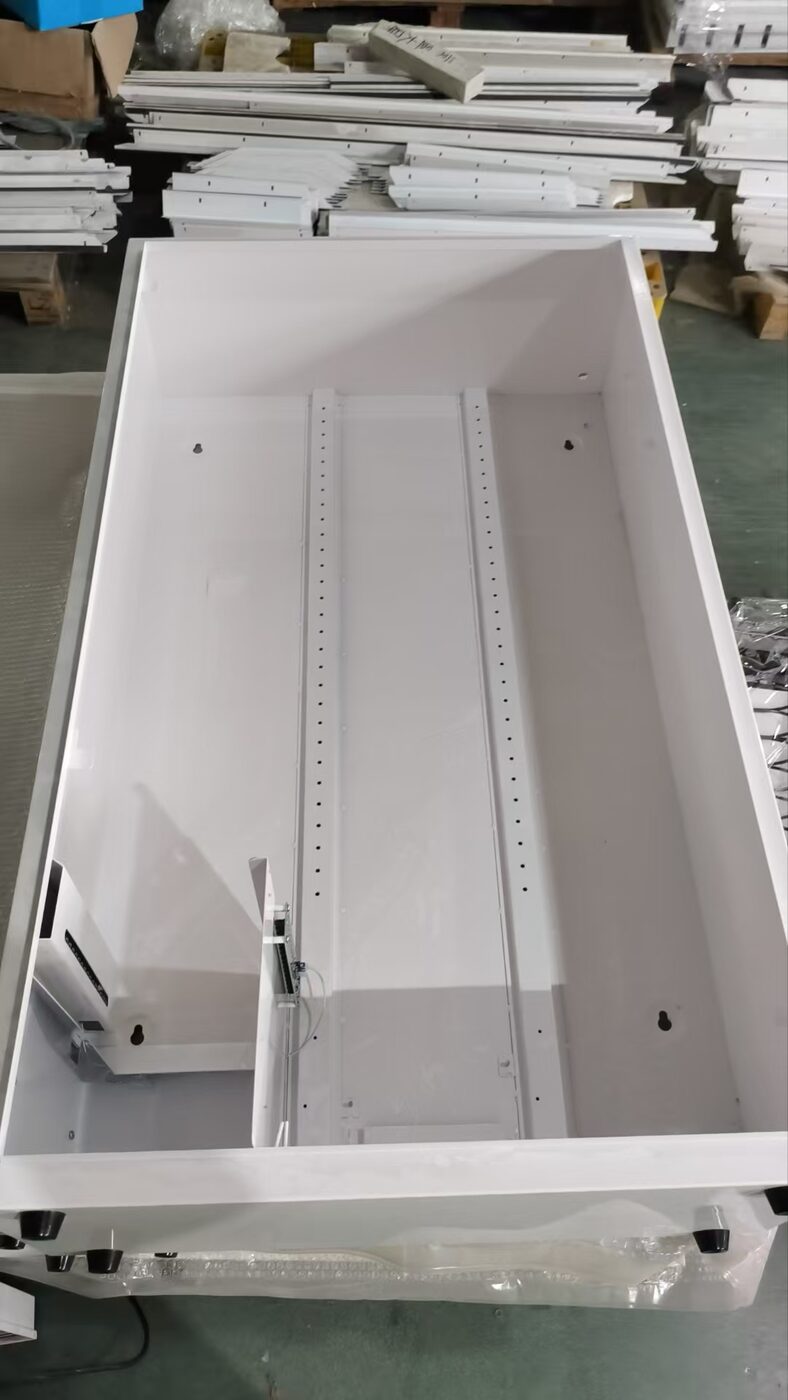
Our first task was translating an idea into an engineered specification. Working from the supplier listing and the product’s packaging dimensions, we calculated the machine’s target capacity — how many units per selection made the machine worth servicing — and designed a custom wall-mount unit around that number.
Because these machines would be installed in diverse venues, we kept the mounting method generic — compatible with both brick and drywall — and supplied engineering drawings for the mounting backplate so local installers retained flexibility. When the client revised product dimensions mid-build, we re-pitched the dispensing coils and sourced replacements from a local coil factory in the same city, turning the new coils around within 48 hours so the build never lost momentum.
The Screen IS the Revenue Engine: Why a 32-Inch Android Display
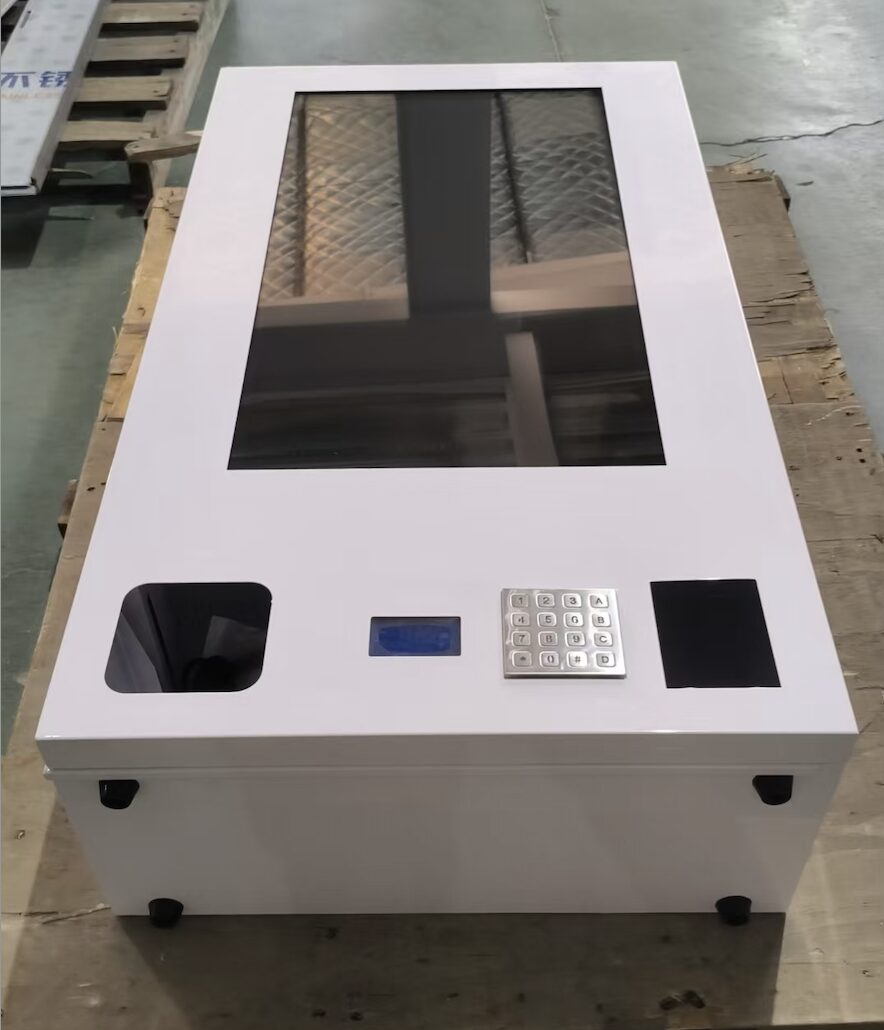
The advertising model only works if the screen commands attention. We specified a 32-inch Android touchscreen on every machine, capable of smooth, high-quality video playback, so each unit functions as an advertising surface as much as a dispenser. We delivered the firmware that ties the screen, the selection interface, and the dispensing mechanism into one integrated system — the screen drives the business model, and the firmware runs both.
Cloud Backend: Questionnaire-Gated Free Dispensing with Usage Analytics
As the hardware and firmware came together, the client expanded the scope to include the cloud platform. The cloud backend and the questionnaire system that gates free dispensing were built by our Australian software partner, Vending on Track, and deployed on AWS — letting the client verify eligibility and capture usage insights while keeping the product genuinely free at the point of use. Running on AWS infrastructure is a capability most Chinese vending factories simply do not have: they can ship hardware, but standing up a production-grade cloud backend on a Western hyperscaler is outside their wheelhouse. With hardware, firmware, and software pulling in one direction, the client had a complete, deployable solution from a single coordinated team. This is our standard model: KioskForce owns the hardware and firmware, and we coordinate closely with Vending on Track for the cloud layer — no finger-pointing between separate vendors.
Build → Crate → Air Freight → Live: The 75-Day Timeline
We built five prototype machines, crated them, and delivered them to the DHL freight forwarder in South China for the cargo flight. The machines were loaded onto a DHL cargo aircraft on 4 June 2025 and landed in Sydney on 14 June. On the ground, the machines were installed and the screens went live with advertising — using our mounting drawings and installation guidance (the physical install was carried out locally, not by us). The client finalised their production URL, and the service went publicly live on 24 June 2025 — 75 days after kickoff.
From 5 Prototypes to 50 Machines: How the Pilot Unlocked Institutional Funding
Those five prototypes did exactly what prototypes are designed to do — they proved the concept and built momentum. With our ongoing support, the startup went on to secure funding from top institutional investors. Later in 2025 they refined the specification to make the machine lighter, and ordered fifty more units to roll out across additional venues. By December 2025 we had handed the entire project over to the client — including the cloud-server source code — so they could stand up their own in-house engineering team and keep expanding on their own terms.
Full Cost Breakdown: Hardware, Software, and Shipping
For a five-machine pilot of this scope, the budget broke down as follows:
- Hardware — about US$20,000 (≈ A$30,000). Five fully customised wall-mount prototype machines, including customisation and international freight — roughly US$4,000 per machine.
- Software and cloud platform — about US$20,000 (≈ A$30,000). The cloud backend and questionnaire system, built with our software partner Vending on Track.
- Total — about US$40,000 to go from a single product listing to five deployable, connected, revenue-generating machines.
All figures are approximate and in US dollars.
KioskForce vs Typical Alibaba Suppliers: What Made the Difference
| What Most Alibaba Suppliers Offer | What KioskForce Delivered |
|---|---|
| Hardware only — you figure out the rest | Full-stack: hardware + firmware + cloud coordination |
| Fixed shelf configuration | Custom-engineered around your product dimensions |
| Generic mounting plate | Engineering drawings for brick AND drywall |
| No firmware development | Custom firmware tying screen, UI, and dispensing |
| No cloud integration, let alone AWS | Cloud backend on AWS with eligibility-gating questionnaire (via partner) |
| Ship and forget — no handover process | Smooth handover: source code, documentation, and knowledge transfer so the client’s in-house team can take over and expand independently |
Project Timeline
T+0 is project kickoff — 10 April 2025, when the client committed to the full build including the cloud platform. Earlier dates (pre-sales and discovery) are shown as T−.
| Date (2025) | Elapsed | Milestone |
|---|---|---|
| 21 Mar | T−20 days | Introduced to the client through our distributor, Automatic Vending Specialist |
| 31 Mar | T−10 days | First discovery meeting — client arrives with only an Alibaba listing |
| 1 Apr | T−9 days | Product packaging dimensions received; target machine capacity proposed |
| 2 Apr | T−8 days | Hardware quoted for a five-machine prototype run |
| 7 Apr | T−3 days | Cloud-server and firmware requirements locked; generic brick/drywall mount agreed |
| ~10 Apr | T+0 | Project kickoff — scope expands to the cloud platform, built by our software partner, Vending on Track |
| 14 Apr | T+4 days | Updated product dimensions; new coils re-sourced locally within 48 hours |
| 14 May | T+34 days | Prototype machines built |
| 17 May | T+37 days | Mounting-backplate engineering drawings delivered |
| 19 May | T+39 days | Machines crated and ready to ship |
| Late May | ~T+48 days | Delivered to the DHL freight forwarder in South China; prepared for the cargo flight |
| 4 Jun | T+55 days | Loaded onto the DHL cargo aircraft |
| 14 Jun | T+65 days | Machines land at the Sydney depot |
| 18 Jun | T+69 days | Installed on site with our mounting drawings and guidance; screens live with advertising |
| 20 Jun | T+71 days | Production URL finalised |
| 24 Jun | T+75 days | Service officially live and public — about two and a half months from kickoff |
| Later 2025 | T+~5 months | Institutional funding secured; lighter respec and a 50-machine order |
| Dec 2025 | T+~8 months | Entire project handed over, including the cloud-server source code; client builds an in-house engineering team and expands further |
Why the Full-Stack Approach Worked
A first-time hardware founder does not just need a factory — they need a guide through capacity planning, coil selection, mounting engineering, firmware development, international freight, installation guidance, and the cloud software that makes the whole system run. By coordinating that full stack — hardware from KioskForce, firmware from KioskForce, and cloud from our partner Vending on Track running on AWS — we let the client focus on their market and their advertisers.
Two things set this apart from a typical Chinese factory relationship. First, the cloud infrastructure: most Chinese vending manufacturers have no experience deploying on AWS or any Western cloud platform — they can build a machine, but they cannot give you a production backend your engineering team can work with. Second, the handover: when the project was done, we transferred the cloud-server source code, documentation, and operational knowledge to the client’s in-house team so they could stand on their own. A typical factory relationship ends at the shipping dock; ours ends when the client’s team is self-sufficient.
The gap between an Alibaba listing and a fundable, deployable business is not just manufacturing capacity — it is integration. And integration is what we do.
If you are exploring a custom vending machine project, the lesson from this build is simple: find a partner who can handle the full stack, not just the sheet metal. A missing firmware layer, a cloud integration gap, or a mounting approach that does not match real-world venues can stall a project before it reaches its first user.
Want something like this built?
We design and manufacture custom vending machines, kiosks and the cloud software behind them. Tell us what you have in mind.
Project brief · 60 seconds
What are we building together?
Three quick steps. Your brief goes straight to the engineers who design, build and support KioskForce systems.

